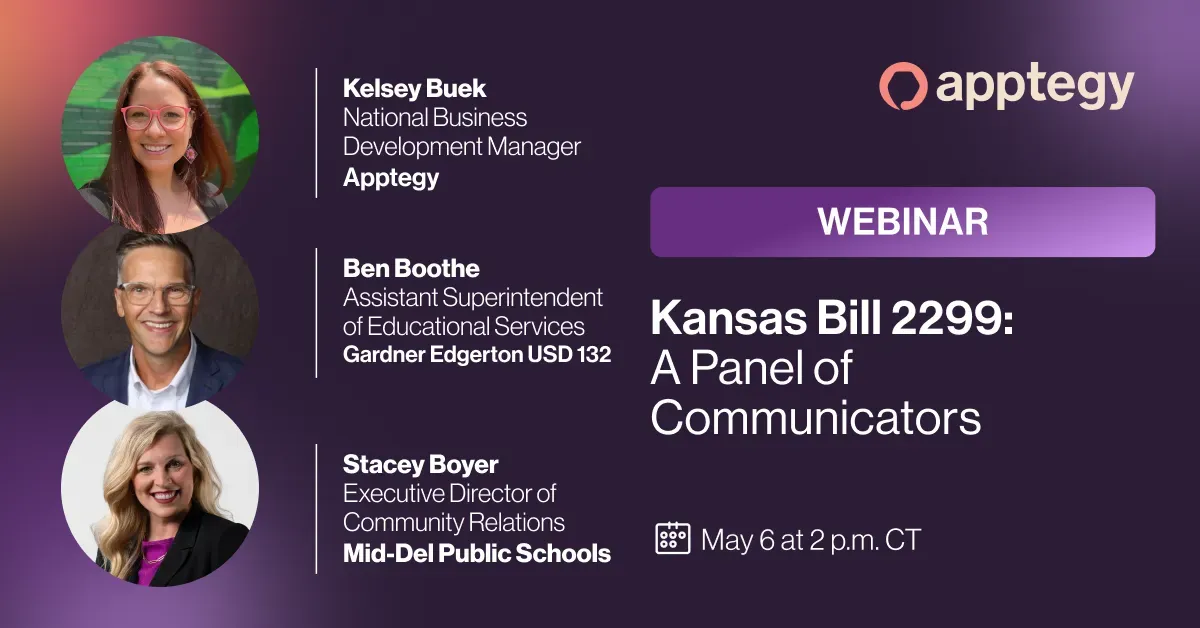
How can schools protect students while respecting teachers' need to effectively communicate? What does a district-controlled safe space for two-way communication look like, and what does it take to make the switch?
Join Kansas school communications leader Ben Boothe and Oklahoma school comms vet Stacey Boyer, alongside Apptegy's Kelsey Buek , for an illuminating discussion on the new reality for K-12 communications.
Related Resources
How to Simplify K12 Two-Way Communication Without Losing Control
Learn how districts can empower staff, protect compliance, and build trust with one secure platform.
The Power of Parent-Teacher Communication for Student Success
Here are a few best practices for building an effective two-way communication strategy.
Webinar Transcript
Kelsey Buek: Alright, so as you all know, here at Apptegy, we a lot of times, get a bird's eye view of communications trends that are happening across the country. One of the big shifts that we're seeing right now is states moving to clarify expectations around how schools manage student communications.
Kelsey Buek: So, of course, today we're focusing on the Kansas House Bill 2299 that they just dropped, and we have a very fast-approaching deadline on, but we do know that some similar, legislation has been passed in states like Oklahoma, Wisconsin, Kentucky, among others.
Kelsey Buek: And so, excited to have two folks joining me that I will introduce here in a second, and I'll introduce myself as well, but first, please, in the chat, if you could give us your name, your location, and a win of the week that we can celebrate with you, that'd be great.
Kelsey Buek: And as we're collecting that, I can go ahead and introduce myself. Hey, Kim, happy to see you here.
Kelsey Buek: I am Kelsey. For those of you who don't know me, I am a Kansas educator. I am joining you today, live from Lawrence, Kansas, Rock Chalk.
Kelsey Buek: I worked at Lawrence High School for 10 years, so I'm a proud Chesty Lion as well, and I grew up in Topeka in the Auburn-Washburn District, so I'm a Kansan through and through, but, huge sports fan, have always been, so you can see me here with my best friend at,
Kelsey Buek: a soccer game, women's soccer, we take that very seriously here, and then with my mom and stepdad at a KU football game, which was very, very fun, because I was cheering on some of my former students, who were playing for KU, and it was Senior Day last year, so that was really fun for me. And then outside of
Kelsey Buek: all of that, I… you can see me also pictured with a goat that was a ring bearer at a wedding I was in. I love all animals. So, that's who I am. Good to see so many familiar people in the chat.
I'm happy to see, like, some really good names here, so…
Kelsey Buek: Joining me to discuss everything today, we've got two stellar folks. A lot of you will know Ben Booth.
Kelsey Buek: He's an assistant superintendent at Gardner-Edgerton here in Kansas, and a rock star communicator. We always love working with Ben. And then we also have Stacy Boyer, who's a chief communications officer in Mid-Del, Oklahoma, just outside of Oklahoma City, and their team is outstanding as well. Of course, Oklahoma has passed legislation similar to this.
Kelsey Buek: So please welcome Ben and Stacy!
Ben Boothe: Thank you.
Stacey Boyer: Thanks.
Kelsey Buek: Perfect. Anything you all want to say before we kick it off?
Stacey Boyer: I love that you did the rock chalk. I have to go with Boomer, though.
Kelsey Buek: The only ones, okay.
Stacey Boyer: OU. And then Jamie with OSU.
Kelsey Buek: Yet.
Stacey Boyer: We don't… we don't talk about the other Oklahoma school. That's okay.
Kelsey Buek: No.
Kelsey Buek: And as you know, like, a lot of folks who do know me know that I have a soft spot for Oklahoma. My mom is from Norman, so yes.
Stacey Boyer: rumors.
Kelsey Buek: sooner, so sorry.
Stacey Boyer: There you go.
Stacey Boyer: Okay.
Jamie Ronck: All good. A fun win of the week in our chat, y'all, is we have someone joining us from Maryland, so it's not all Kansas and Oklahoma people.
Ben Boothe: There you go.
Kelsey Buek: I love that! Welcome, Maryland! I am jealous of the crab cakes, always.
Kelsey Buek: All right, we can go ahead and kick things off. I've got some questions for Ben and Stacy. I'm very excited, and again, drop your questions in the chat. Jamie and Barrett are here supporting us with that, and so, please feel free, anything, we'll try to get it answered for you, but…
Kelsey Buek: I want to start with just kind of setting some of the context behind this House bill. So, Ben, we're going to start with you.
Kelsey Buek: To kind of set the stage, can you give us kind of a high-level overview of this bill, what you've been hearing, what the primary drivers and concerns have been that led to the legislation being drafted?
Ben Boothe: Yeah, that's a… that's a lot of… that's a big question. So, I would say that, you know, where this has derived from is, the House bill, is that the… the legislature wants to ensure that there is oversight
Ben Boothe: with schools and communication with students, primarily. And I think at the core, it's to ensure that we're protecting students, and protecting staff.
Ben Boothe: Because up until this point, many districts had not required a single, platform to communicate, and had not been explicit about what folks could.
Ben Boothe: And couldn't use. So, basically the bill eliminates private communication with students or through social media, and requires that districts provide a means of communicating.
Ben Boothe: So that's… that's what this bill does. Now, I think we're going to get to those other things that you mentioned here in a little bit, so I'll… I'll stop… I'll stop there, but that's the purpose of the bill.
Kelsey Buek: Great. Thank you, I appreciate that, because it's…
Kelsey Buek: You know, confusing for a lot of us. So, Stacy, you've actually lived this in Oklahoma, I think it started about 2 years ago for you all there, so what was that transition like for you all, and what lessons can our folks here in Kansas and Maryland learn?
Stacey Boyer: Well, I think, what we experienced in Oklahoma, it was rapid fire. The law was passed in May.
Stacey Boyer: And when do schools get out in Oklahoma?
Stacey Boyer: May! So… and it was taking effect July 1, actually, not even when we started back to school, but July 1.
Stacey Boyer: So, everything was a sense of urgency in Oklahoma, and I think the same premise, Ben, what the intent behind the law was very similar to what you're experiencing there, but we did not have a lot of turnaround time.
Stacey Boyer: And so, I know I'll talk more about Apptegy, and really how they saved us with that process… how you saved us with that process.
Stacey Boyer: But for us, it was immediate. I could go on and on. You just tell me when. I could tell you the whole… you can tell the whole story.
There's a whole story, but I don't think we've ever had to act so quickly and with such a sense of urgency, and to really help our staff understand that
Stacey Boyer: that we weren't out to get you, it was we were here to protect you. I think that was the biggest thing, when we were communicating with our teams, was the fact that we were trying to be very intentional with the decisions that we made to provide a vehicle to handle the communication, and that they would be protected. So…
Stacey Boyer: Yes, the whole onboarding process was very rapid, in Oklahoma for all of our school districts. So, yes.
Ben Boothe: I would also, just to frame our situation, our school district specifically, I'm sure we've all worked with board members who have lots of great ideas, lots of great ideas, and maybe don't understand our capacity.
Ben Boothe: And so, about 2 years ago, he had approached us after going to a conference, a school board conference.
Ben Boothe: and being hit up by some vendors to come up with a district-wide communication tool. And so that was before… there had been conversations in the legislature, but… so we were actually, fortunately, in this situation, he did have some foresight.
Ben Boothe: And we adopted, a single platform, not a single platform, but a unified platform,
Ben Boothe: a year prior to this bill going into effect, and so I feel for Stacy, because we did not
Ben Boothe: it was a challenge to get everybody over to one platform, and so I don't know if it would have benefited us, the timeline would have been shorter, but we didn't feel rushed in doing it because we'd already had it in place.
Stacey Boyer: Yeah. No, the rush was definitely on in Oklahoma. I think everyone was feeling it. We also had a different administration at the time, too, so I think in Oklahoma, we were always on edge for decisions being made, at the state level, so…
Stacey Boyer: with that in play, too, we all knew we had to meet the deadline, because we would definitely be under fire if we did not meet that deadline. So, for us, it was very quick. Luckily, we were already with Apptegy, so…
Kelsey Buek: here.
Stacey Boyer: all had already maintained our, you know, our website platform, and how we communicated with families through alerts and things of that nature. So, it was just a natural transition for us to add the Rooms platform with what we did.
Stacey Boyer: And you just let me know, I can talk about training, how we kind of rolled that out, because it was summer. And in the summertime, everything is pretty much voluntary.
Stacey Boyer: to your staff. So, the minute that that was passed in May, we immediately, I think,
Stacey Boyer: signed a contract? Jamie? Probably. Think back to Jamie, probably in June, or July.
We had… I think it might have been June, so that we could start really kind of in July. We worked with a few groups. The hardest working groups in any school are your band program.
Stacey Boyer: And, I mean, that is just the fact. They practice all summer long, even more so than your student athletes. And so, we worked with a few groups just to try to get them situated, but
Stacey Boyer: Everyone loved to text back in those days, and have your group me's, and all those things, and there was really not a way to be accountable
Stacey Boyer: with families, or with supervisors, using that as a method to communicate. And, having the Rooms platform when, you know, we started training them, and I really… I had some really strong heart-to-hearts.
Stacey Boyer: With our staff, and we love kids. We want to do the best for kids. We have a lot of title… title schools in our district, and so we have a lot of situations where some kids
Stacey Boyer: You know, it's hard for them to get where they need to be, and there was a lot of checkup with our staff and those kind of things. But when it came down to it.
Stacey Boyer: I always express to my staff.
Stacey Boyer: Remember, this is law. We love our kids, and we want to do the best thing for our kids, but ultimately.
Stacey Boyer: you have a job, you have a family, your own family, and we have to be accountable, and what does that look like? And so, we had a lot of hard discussions, and everything was truly rapid fire, just to be ready for the July 1 date, but…
Stacey Boyer: We got there, and I'll have to tell you how we did district-wide training for the State Department in a minute.
Kelsey Buek: That was funny. Yeah, perfect.
Kelsey Buek: Perfect. I know, we're definitely gonna get to that, because it's…
Stacey Boyer: I could go on and on, on and on.
Kelsey Buek: Yes. Yeah, and I feel like a lot of what both of you said is kind of, like, a really good segue into what I want to talk about next, because what we're seeing, like, the core part of the issue here is that we are trying to protect students, but still allow, like, our teachers, our club sponsors, our coaches, everyone who's working in the districts to do their jobs effectively. So, I do, you know, I… for those of you who know me, I'm a former teacher in
Kelsey Buek: I was one of the stubborn ones, so I completely understand that it's hard to come in and say, this is what we need you to do. So, Ben, what are some of the biggest anxieties that you're hearing from your staff regarding the rules, and how are you addressing that?
Ben Boothe: Yeah, so I think one of them is, am I going to get in trouble for communicating with students, or in, you know, the form of communication I'm using?
Ben Boothe: is going to create an issue. And so, we've gone back to reminding them, kind of like what Stacy just shared, is giving them the why. You know, we're big believers, and people…
Ben Boothe: are pretty compliant, or, you know, accepting if you share with them why. Why something's required. And so, that's where we started, and back to Stacy's point again, yeah, this is… this is for
Ben Boothe: students to protect students, and I mean, when you get really right down to it, this is to protect students, but we've also shared with staff, this is also to protect you.
Ben Boothe: And so, if you're ever accused of something, you know, it's gonna be much more difficult to defend you if we can't have a log of what's taken place.
Ben Boothe: And so, just helping staff understand that, no, you're not going to get in trouble, and we're providing you the tools for
Ben Boothe: to… for which you… to which? Which? Which you can use, to communicate with them safely. And… and like… like, we've talked about, or maybe I mentioned a little bit earlier, it's not just rooms.
Rooms is a primary driver, but, you know, we still remind them they can use email, just because we can always access email.
Ben Boothe: And… and phone calls, right? Using… using district phones. And so, it's a shift away from those rogue programs that are not… they're not rogue, but just,
Ben Boothe: band, and Remind 101, and… and… and trying to consolidate that. So, that… that has been the primary, thing that we've heard is, you know.
Ben Boothe: how can I avoid, getting in trouble.
Ben Boothe: With the new statute.
Kelsey Buek: Yeah, that's… that's a great point. I mean, of course, none of those things are going rogue. They all have the best intent. We understand that, but yes, when it needs to be monitored, that… it's good to have it all in one place, so…
Ben Boothe: Yes.
Kelsey Buek: Stacy, I'm curious, because especially, I mean, I remember this post-COVID, I was still in the schools. Parents are expecting instant updates from their kids, and from the schools, and full transparency on everything, so…
Kelsey Buek: How are you able to stay compliant, but also give them kind of, like, a sense of ease, but also connectedness?
Stacey Boyer: Right, I think… oh my goodness, my kids are now out of… got one still in college, but, I think back to getting the ClassDojo updates when my kids were in elementary school, all these different platforms. I think what we've done is…
Stacey Boyer: We truly over-communicate.
Stacey Boyer: And I think that's what our parents, expect. I think…
Stacey Boyer: we look at the generational family units that we serve. You know, we've got grandparents that need it a certain way. We've got the young parents who never want to call the school, they just want to get a text, or whatever that looks like. And then you've got the in-between, that they want to see, you know, 80 pictures posted on Facebook.
Stacey Boyer: of an alphabet parade. I mean, you just never… you have to over-communicate all the things that you do. And I think we try that. We look at different avenues of how we communicate, but bottom line is, we all… we always try to center that back.
Stacey Boyer: to our platforms, because…
Stacey Boyer: the ease that we have by having the one platform, you can share it once, and it distributes to all of your different social platforms, as well as your emails, your texts, your phone calls, and good things like that. And you know, Ben, I'm going to chime in on something you said.
Stacey Boyer: I had an experience this past year, and we've been using rooms, but it was one of my activity teachers, I'm not gonna say which one, and, they really wanted to bypass.
Stacey Boyer: They decided they just weren't gonna do it, and what they were doing is they were using a parent to communicate for them. They were sending messages, and they were using a certain app to communicate that.
Stacey Boyer: Until things went awry.
Stacey Boyer: And they realized the individual who was not a staff member was communicating not all the information, and not correctly, and with a bias, and
Stacey Boyer: And I had a really nice conversation with them, and I… not I told you so, but I said, these are the things that can happen when we're not in control of the situation, and that's why it's so important to have a platform where we can truly
Stacey Boyer: Watch the communication happening, for that very reason, to protect the staff member, as well as the students, and you help alleviate some drama that does ensue.
Stacey Boyer: as we all know, when it comes to communication and student activities. So, that's my sidebar on that.
Ben Boothe: Yeah, I think, our staff may…
Ben Boothe: perceive that this is, we're trying to be Big Brother, or we're micromanaging them, but I'm guessing that most of the folks on this call, know none of us have time to do that, like.
Stacey Boyer: Right.
Ben Boothe: We're basically going to this in the event of an issue being brought to our attention. We have other methods to proactively monitor,
Ben Boothe: You know, threats or, threats to self-harm.
Ben Boothe: So, you know, this is… nobody has time to go look through all these threads, and so, you know, we had to help them understand that as well. And we had a few… we had a few staff members who…
Ben Boothe: You know, when push came to shove, they…
Ben Boothe: we had to go and have an individual conversation with them and say, this is, you know, we understand your frustration, you know, we want to make this tool, Rooms, meet your needs,
Ben Boothe: And… and… but this is the way it's going to be, and so there were a few holdouts, but everybody's on board now, and we're a year in, and, you know, you don't hear any… any complaints.
Stacey Boyer: Yeah, that one staff member I was referencing is probably one of our largest users now, and so… they're a believer. They're a believer once they've figured it out. I mean, it's just a… it's a different platform, and it's still going to that same telephone that those families were using, so…
Ben Boothe: Yes. The other thing Stacy said, we're a very, actually have to laugh if people say our communication department, because that's… that's not a thing. There's no department. So we are always looking for ways to be efficient.
Ben Boothe: And, you know, so when we create a message, we want to get as much mileage out of it as possible, and so, like she mentioned, rooms, to get it out to multiple platforms in one click, is a huge help as well.
Ben Boothe: From a district… from a district perspective. And staff, teachers being able to push it out multiple ways.
Kelsey Buek: Absolutely, absolutely. And I know, again, I said I was a stubborn teacher and counselor, so I would have been feeling this pressure right now. And so, yeah, we're talking a lot about these district-controlled safe spaces here at Apptegy, because we are seeing this kind of across the U.S. right now, so…
Kelsey Buek: you both have kind of talked about what that looks like for you all, but I'm curious then, like, what features are non-negotiable?
Kelsey Buek: For both of you, and it's okay if they're different when you're looking at making a switch to a different platform.
Ben Boothe: Yeah, so, you know, I was thinking about this question and wrote down a few things. So, it has to do several things at once. One, it needs to be easy enough for a coach, or a teacher, or a secretary, if they're the one sending out the message for the principal, for them to pick it up and use it.
Ben Boothe: And that certainly is the case with rooms. I mean, it is intuitive, and I think most of us are to a point where… and most of the software programs we're seeing
Ben Boothe: In general, have the same kind of navigation feel to them, so it had to be easy for people to use.
Ben Boothe: It needed to be transparent, for families to be able to, see what was being communicated. Also, so they could, you know, have more of a single source, one location, because, like all of you, we have parents who have students not only in different buildings, maybe have an elementary, a middle school, or a high schooler, so they could have three different buildings to begin with.
Ben Boothe: But then, they're in different activities with different sponsors, so now you're talking about, I mean, you know, a ton of people that could be communicating with them.
Ben Boothe: And then the other thing is just making sure it's secure enough so that we can monitor it, we could retain the messages, we can go back and look through them. So, non-negotiables, you know, they needed to have required user accounts.
Ben Boothe: Not personal accounts, parents and guardians needed to be able to see it. And then, archiving, retention of the information, and then also, administrative access so that we could, have oversight after the messages had been… after the message had been pushed out, so…
Ben Boothe: Those were the non-negotiables for us when we were looking for product.
Stacey Boyer: I think you hit all of those topics. One thing I would add to that, something that
Stacey Boyer: I think working with… I've worked with different, vendors through the years. I've been here for working on 22 years, and
Stacey Boyer: customer service is huge for me. I need to be able to, after we have school sites.
Stacey Boyer: trained, they have to be able to access customer service and ask the questions, because, again, who has a huge communications department? None of us do. And I'm on my phone 24-7 anyway, as it is, but
Stacey Boyer: I… every time I sit down when I'm training someone, we always click on the cute little icon at the bottom, and I have everyone check in with customer service because I want them to be able to ask a question and see how easy it is. And… and having that at all times. And Jamie knows I've had some…
Stacey Boyer: I've had some emergencies. I do a lot of crisis communications, but I… I may have an emergency and may need to call her, or be able to call our rep, and we will get on the phone instantly, and the support, that Apptegy has provided me through the years has been invaluable. And so that is something that, when I'm looking at a vendor, I… customer service has to be very important.
Stacey Boyer: That's a very important aspect, but that's something that all of our staff
Stacey Boyer: I ask all of them to do is chime in, ask a simple question. It may just be, hey, I'm training, and I just wanted to see what it looked like, or whatever that is, but having all of those videos and just different resources at their fingertips at all times.
Ben Boothe: Yeah, that is… I'm glad you brought that up, because maybe I'm biased as a Apptegy customer.
Ben Boothe: maybe I'm not, but, the one… the one thing, one of the…
Ben Boothe: strongest attributes I think Apptegy has is their customer service, and that has been the case since day one, and I have said…
Ben Boothe: many times, in many settings, that Apptegy has provided the best customer service, regardless of product in this industry. And so, I'm not getting paid for that, but that is the case, and so much so that when…
Ben Boothe: I tell our buildings, when they contact me with a website question, I said, you are better off contacting Apptegy, because you're going to get a faster response from them than you are me.
Ben Boothe: And also, the product is so easy to use that, we've trained our, building,
Ben Boothe: Webmasters, one time.
Ben Boothe: 7 years, and that was the beginning, and we've not provided training for them since, and they've not asked for it either, so that just speaks to how easy the product is, and on… and back to why we're here today, you know, I would say the same for rooms. Very intuitive.
Kelsey Buek: I love to hear that. I mean, a lot of people know I'm traveling coast to coast. That's a big part of my job here at Apptegy, and that is one of the biggest things I hear almost every single day. It's the customer service, so I love that you both brought that up.
I think, including Barrett and Jamie here, we just…
Kelsey Buek: hire really great people who want to help. So, I know that it is tough, though, getting an entire district, especially districts both of your sizes, and of course, we know that there are districts way larger than yours to go away from their, to use your word earlier, Ben, rogue communications platforms to one centralized platform. So.
Kelsey Buek: How are you approaching… how did you approach the switch, since it was last year that you did this, VIN, and actually really generate some buy-in?
Ben Boothe: Well, one of the first steps we took was to acknowledge with our staff that, you know, we don't think there's any ill intent in the apps you've chosen to use.
Ben Boothe: And when there's…
Ben Boothe: regardless of what the topic is, when there's lack of oversight, people are gonna fill the gaps that we're… they're gonna fill the need. And so, every coach
Ben Boothe: Usually, Spanned, has a different need, right? And they've found a product that they… or a software platform they like.
Ben Boothe: And unfortunately for our families, frankly, it's usually different platforms. And so, you know, we started by acknowledging, like, hey, we…
Ben Boothe: we understand why you're using all of these. We get it. But then we start, you know, the second thing, 1A, if that's 1A, then 1B was making sure they understood the why. And again, this was all before the… in our case, it was all before the legislation… the legislation was in place.
Ben Boothe: And… but I think we… people hopefully can learn from us and our mistakes, that helping them understand the why, and it's not, you know, to Stacy's point, like.
Ben Boothe: what you said about, you know, it's law. That's great when you get down to the final few and say, you are going to do this because it's what's required.
Ben Boothe: I hope we were able to convince most of our folks that we're doing this. Again, like I said a little bit earlier, yeah, it protects students, but this protects you. This protects you as an employee, and so don't put yourself in a bad spot.
Ben Boothe: Other things as we went through, the switch was training, providing training specific to a person's role.
Ben Boothe: So,
Ben Boothe: you know, I know I mentioned training one time, but that… this was 7 years ago. Now I'm talking about rooms, which came out several years later in new products, so we went to… we provided training for each group, so for administrators, it looked a little bit different. For teachers, it definitely looked different. For our, our coaches, it looked different.
So, providing training that was specific to their… their needs.
Ben Boothe: And then…
Ben Boothe: just reinforcing the expectations, so it wasn't a one-off, and then we left. We would constantly swing back around and either use it ourselves as models, or, reinforce, like, hey, as a reminder, passive-aggressive is the way I like to define it. It's like, hey, as a reminder, so we know you're using rooms, and so, this, you know, this or that, so…
Ben Boothe: Versus, we hope you're using rooms.
Ben Boothe: So that… those were… those would be items I would give consideration to as you're thinking about the rollout.
Kelsey Buek: No, that's really great to know, and then, so, Stacy, looking back at your rushed timeline in comparison to Ben's, like, of course hindsight is 20-20, so what's something that you wish that maybe you had done differently in order to communicate out the protocols to your staff, your community, or anything?
Stacey Boyer: Yeah, I, you know, it seems like that whole period of time was a blur, just because…
Stacey Boyer: you know.
Stacey Boyer: In addition to us rolling that out, all of our staff had to basically go on our State Department of Education's website and say, I've been trained. We had to provide documentation that
Stacey Boyer: all of our employees had been trained, so that's my funny story. So, that… everybody has the time where all of your staff comes back to the beginning of school, you're all… ours is called Convocation, and so…
Stacey Boyer: Dr. Cobb, our superintendent, who's great, and he's also funny, we decided, you know what? We have all of our staff at Convocation. It's the glorious kickoff start to the new year.
We talked about it.
Stacey Boyer: So, Dr. Cobb just decided to talk about the law.
Stacey Boyer: And he decided to flip through the training slides that the State Department of Education provided.
Stacey Boyer: And so we went through all of the slides as a team, so then we were all officially trained on the state communication law. I mean, I don't know any other way that we really could have done it anyway, but there might have been some humor, added to it, but,
Stacey Boyer: it also… he also, by doing that, outlined the importance of what it was, and what the intent was. And I think our law in Oklahoma is different than what you've experienced in Kansas. I, as a family member, if I texted one of my cousins.
Stacey Boyer: I would have broken the law, because I was not an immediate family member. So we had an extreme law that did not provide any gray areas, so in addition to us doing the training.
Stacey Boyer: there truly was a lot of anxiety and communication, so I think everything was really heightened, for us for a period of a year. They've gone and changed… modified it a little bit, so it's not as extreme, but…
Stacey Boyer: Yeah, I think people are a lot more relaxed now. Something that I do really like and value is when we first started Rooms.
Stacey Boyer: we would notice some things that we wish we could do. And I love the updates. So I think as Rooms has continued, there's been, new little, you know, bits and pieces that have changed a little bit.
Stacey Boyer: I think once everybody really was working in it, we would… we would see something like, oh, I wish it could do this, and I felt like there was always an update coming up, and they said, oh, well, you lucked out, because we're about to have that. So I think everybody really working through that process, too, and I love, as a…
Stacey Boyer: Client to be able to provide support, provide, you know, provide
Stacey Boyer: suggestions, and then things… you guys are ahead of my brain anyway, and things being rolled out to just continually improve the product. So, I appreciate that.
Stacey Boyer: So we did bare bones to get rolling, and then we kind of expanded on that, but that… I think that was really due to the timeline that we were… we were given. So, yeah.
Stacey Boyer: Love it.
Kelsey Buek: Absolutely. Ben, I saw you nodding along to some of that.
Ben Boothe: Yeah, I'm just continuing to throw love towards, Apigee. You know, the… I would echo the comment about updates and being receptive to feedback.
Ben Boothe: And I… I feel like that's been the case. I've experienced that to be the case, ever since… even with just the website and the communication tools prior to Room, so…
Ben Boothe: It doesn't surprise me that, you know, Rooms is getting updates based on customer feedback. So, and I would say that early on, and we're still working through a little bit.
Ben Boothe: is that the coaches would have some very unique needs, which were legitimate. Like I said, we acknowledged there were some legitimate
Ben Boothe: components, aspects that Rooms was not capable of when it first rolled out. And so we had to acknowledge that, and that's where we went back to coaches and sponsors and said, well, okay, so what's the workaround, you know, for their individual situation?
Ben Boothe: Because it's not perfect, right? And… and it continues to grow, and it'll get there, but,
Ben Boothe: But that's, you know, I found that with all the products, is that there's just constant, improvement and receptive to feedback.
Kelsey Buek: Yeah, absolutely. I love that. But of course, you know, we… we do have to talk about a bit of an elephant that's in the room, because, as everyone here in Kansas knows, what you saw, Stacy, in Oklahoma, is that a big stressor for a lot of districts right now is that
Kelsey Buek: This is an unfunded mandate coming out, and of course, we know it's a pretty quick turnaround, because we are at the end of the school year already. So, districts are expected to roll out whatever compliant, secure platform they can.
Kelsey Buek: And they're giving… being given no state dollars to do this. So, Ben, how are other Kansas district leaders and yourself navigating the financial reality of it?
Ben Boothe: Yes, yeah, so, you know, and to add to your point about,
Ben Boothe: the… the timeline, the timing, budgets have been spent, or allocated, right? And so,
Ben Boothe: And if, for those… or my Kansas friends, we were also just mandated to implement a cell phone policy, restriction policy, if you didn't have already one. Again, we're fortunate in our situation that we are pretty far down the road with ours, and so it's not as big a shift, but if you didn't have it.
Ben Boothe: There's gonna be some expense that comes along with that mandate as well, whether district ends up going with pouches, which there's other ways to do it, but there's gonna be…
Ben Boothe: in some form, I would think some expense for any district, and so another unfunded mandate, right here at The Wire. So, just wanted to remind folks of that. But…
Ben Boothe: So, with it being, my suggestion for those that are just, like, hey, we gotta go now, is to, as you approach the superintendent, and hope the superintendents
Ben Boothe: Approaching the board with you to say, you know, this already… this is about alignment and efficiency.
Ben Boothe: And it already is in alignment with, at least for our district, what we want to do, and that is, increase family engagement, and so… and make things easier and more accessible for parents. So, by
Ben Boothe: Streamlining and minimizing the, the, the channels for communication, we think that helps. Also, you know.
Ben Boothe: from a budget standpoint, is auditing what you already have. And so that's where, like I mentioned earlier, that's where we started, was with an audit of what we already had, and staff using, and frankly, we didn't know a lot of the tools that the staff were using, not to their fault.
Ben Boothe: We just didn't know, and so we started by auditing and getting a handle on what was in use already. And then, if any of those, were overlapping, we had that conversation.
Ben Boothe: And then finally, just, again, identifying exactly what we need. Whatever tool it ended up being.
Ben Boothe: Bean, is what exactly did we need it to do, and what
Ben Boothe: did coaches and even teachers and sponsors really need the tool to do? Because what I need to do… what I need it to do, or principals needed to do, is going to be vastly a lot different than what coaches and teachers are going to need it to do. So, that's where I would start, is having… is taking inventory… taking stock.
Stacey Boyer: Okay, so…
Kelsey Buek: Absolutely.
Stacey Boyer: That's… I have to speak on this. You just… so Oklahoma, we are… we are in our first year of not having cell phones, headphones, the whole bit. You can have district-issued devices, and I will say,
Stacey Boyer: The beauty of the rooms, and Apptegy is, we added, we use Canvas.
Stacey Boyer: In Middell, and a lot of the districts do here in Oklahoma. And so, on our, our page where all the students will log in on that platform page, you also have the login to rooms.
Stacey Boyer: So, that was a concern that I, you know, when we were talking about coaches might message students all day. They may say, hey, meet on the practice field, wear this white jersey, you know, what is this… what does this look like? So…
Stacey Boyer: the phones are going to be put away, and so that's something that we've all experienced, and actually, I think we all really like it in Oklahoma, because the kids are actually looking up and not down while they're walking down the halls and all the good things. It's amazing what conversations can be had. But…
Stacey Boyer: the beauty of it is, they still can access rooms from their device with the login screen, so we aren't really seeing a decrease on that, so we still have our staff that can communicate that way, as well as Canvas in our district, so… but when it came… when it came down to it.
Stacey Boyer: you know, we have a lot of unfunded mandates, I think, in education, and… and we had to bite the bullet. I know everything comes with a price tag, but I agree with you, Ben. I mean, the communication's completely streamlined.
Stacey Boyer: There's accountability, there's tracking. Tracking is really important to me, where I can look and see if a parent
Stacey Boyer: Received a phone call, but they… they hung up, or it went to their voicemail.
Stacey Boyer: You know, you've got that. We… the ability for our staff to actually send a text.
Stacey Boyer: through the platform. I mean, you have all… you have all the different ways to communicate with families, and I think it's important, but I also… we're… we're pushing the information out, but we can also see when someone's saying.
Stacey Boyer: call, I didn't get a text. Well, but you did, and you hung up. Or it went to your voicemail, or, you know, your phone's disconnected that you provided when you enrolled, you know, whatever the case may be. But being able to track all of that information, it's not just
Stacey Boyer: What we're pushing out, it's also what we're able to see behind the scenes, too.
Kelsey Buek: No, absolutely. That's one of the big things, that people cannot turn off the read receipts inside rooms like they can in their cell phones, right?
Stacey Boyer: Yes, yes.
Kelsey Buek: Yeah, and Ben, you were… you were kind of hitting a lot of points that I'm glad that you talked about, like auditing those tech stacks that you're using, and, like, maybe being able to cut out multiple line items by bringing all the tools into one.
Ben Boothe: And I think, yeah, and back to the point of parents with that, is if parents know where to go, right, they're more likely to stay informed, and I think, you know, I'm a parent of a…
Ben Boothe: 12- and 10-year-old, and all of their outside-of-school activities, you know.
Ben Boothe: It… it's… it's a management nightmare, trying to remember which, you know, the volleyball… where the volleyball group is, and where my son's youth soccer group is, and like…
Ben Boothe: it's… it's exhausting, and so I do think it helps parents,
Ben Boothe: You know, stay more… stay better informed.
Kelsey Buek: Absolutely. I bring up a point all the time. When I was at Lawrence High School, we were a very diverse community with the college here being so close to Kansas City, and I was the English language learning coordinator in the building. 1,600 students at Lawrence High, a lot of them did not have English as a first language, and trying to explain to a parent
Kelsey Buek: a third-party system when they're not already speaking English, when instead I could have said Lawrence Public Schools, just like Gardner-Edgerton schools, just like Middell Schools, it makes a big difference. So, I think, yeah, bringing it all into one, that's…
Kelsey Buek: So easy.
Ben Boothe: Yes. But…
Kelsey Buek: Yeah, Stacy, I guess, back into the budget questions, how are you… because, as you said, the budget is spent by the time we get to May, right? So how are you able to get Dr. Cobb and the rest of the board and everyone to see and allocate funds for you to do this?
Stacey Boyer: Well, I will say, I am very fortunate to have a superintendent that truly believes in communication, so I have to start there, because not everyone sees the value, and what that looks like, and the importance of communication. And so, first and foremost.
Stacey Boyer: when Dr. Cobb is very supportive of it, he'll fight for it also. And so I think that's part of it, and understanding…
Stacey Boyer: there wasn't a workaround. I mean, for us in Oklahoma, there truly was no workaround. And so, we really had to,
Stacey Boyer: You know, find a way. Find money somewhere that, you know, maybe we had to hold off for a few months for the other, and then just, you know.
Stacey Boyer: do whatever we had to to make it work. Because we didn't have any time, so it was… it was a matter of an emergency for us to get it passed.
Stacey Boyer: with our board. But I think the board understands, you know, Oklahoma was in a very different climate,
Stacey Boyer: politically, and so our board members were very active, too, and kind of understood that. We also spoke with our local legislators, as well, shared concerns, for things, knew that things were probably going to be tough that first year, in hopes that things would get a little bit better, but…
Stacey Boyer: Yep. Sometimes you just have to make it work.
Stacey Boyer: Right.
Kelsey Buek: Absolutely. You, you do.
Stacey Boyer: It's an alternative! I know, right?
Kelsey Buek: Yeah, and like you said earlier, a lot of, you know, unfunded mandates coming through.
Stacey Boyer: I'll interrupt you.
Kelsey Buek: And we're seeing that… seeing that everywhere. Not just Kansas, not just Oklahoma, potentially Maryland. Sandy, we see you out there. This is a growing national trend, so…
Kelsey Buek: kind of, as we get close to wrapping things up, I'm… perfect, Sandy, I'm getting… I'm curious, like, what advice both of you have to district leaders, both locally to you, but also in other states, as we're watching the legislation come out.
Kelsey Buek: Across from everywhere, and just… how can you proactively prepare?
Kelsey Buek: Yeah, big question.
Ben Boothe: So, I would… I would suggest not… it's a little late for my Kansas friends, but suggest not waiting, until the bill is passed, because then you are… and I'm not suggesting that that's what happened in Stacy's case. Even ours was, I think, a little bit under the radar for folks.
Ben Boothe: But I think we're seeing enough
Ben Boothe: examples, Oklahoma, now Kansas, if you're not here, that it, you know, legislators are making it clear that they want this, right? That they want this transparency, that they want school districts to have a consistent, not the same one, but a consistent communication platform that can be, reviewed, can be audited, those kind of things, like we talked about.
Ben Boothe: So, that to me, if you're in a state where maybe it didn't pass this session.
Ben Boothe: You need to be thinking about it and approaching your leadership, and having the conversations about budgeting and potentially earmarking money for that
Ben Boothe: For that, what could become a requirement. And so, I think that… that is a starting point.
Ben Boothe: And then, you know, I know the points I…
Ben Boothe: had for this part of the conversation I've already hit on, you know, auditing what you have.
Ben Boothe: You know, finding out what the need is. These are all things that can be done well in advance if you… if you have time.
Ben Boothe: in Stacy's situation, that's not…
Ben Boothe: Not possible. So if you're not in that situation, those are the things that I would… I would start with, so…
Stacey Boyer: I… and I would… I would say, too.
Stacey Boyer: While the circumstances were not ideal that pushed us in this direction.
Stacey Boyer: I am not opposed to this situation. I think it's great to have communication coming from one, one direction.
Stacey Boyer: Because…
Stacey Boyer: boy, that really helps everyone sharing the same message. It helps alleviate a lot of confusion. And so, while the circumstances were not ideal for us, just the immediate turnaround and not the budgeting, I think it…
Stacey Boyer: is a good idea to have, a platform that does allow for that to happen. And Ben, I know we can both attest to the fact of how easy it is.
Stacey Boyer: Because I, you know, I can sit on my phone from anywhere and send out messages from an app from my phone, and that's a lot different than what I have experienced of not having any social media accounts when I first started here. So, that's… it's just a whole… it's a whole different world. And…
Stacey Boyer: And it helps our, it helps our families. I mean, ultimately, we want to communicate as best and as clear as we can with our families, because those are… those are the families, you know, we serve. I mean, they're our clients, so to speak. And so I think that…
Stacey Boyer: moving that direction is a great option if you're a bit, you know, if you can. Sometimes you might have, you know, feet held to the fire, and you're going to be moving a lot quicker, but, I think it's a great communication effort for school districts if they haven't gone that direction yet.
Kelsey Buek: Absolutely, and both of you talked about the cell phone bans as well. Sandy just commented in the chat that she saw that it was all kind of folded together here in Kansas, so yeah, I think being proactive and making sure it's something that your students can also access from their district-issued devices is a huge, huge part of it.
Kelsey Buek: So I'm glad that you both have figured out ways to do that as well.
Kelsey Buek: So, I guess next, like, let's look up… let's look to prep other people. If you could pick just, like, one thing, one bit of advice for communications leaders, assistant superintendents, superintendents, because we know a lot of districts in Kansas don't have communications teams.
Kelsey Buek: Just a little bit of advice, one thing for them to do to prepare, what would you tell them?
Ben Boothe: Yeah, I know I said this several times, but to be more specific, you know, an audit or a simple inventory of what you have, and asking questions like, okay, when you're looking at an app or something that a coach is using, does the… when you're evaluating these, does the district control it?
Ben Boothe: You know, do we have control over it?
Ben Boothe: And you'd need to answer yes. If it's… Can parents access it, right, or view the communication that's taking place? So, if…
Ben Boothe: hopefully nobody's doing this any longer, but if you're texting a student, then the parent really can't see it unless they actually get ahold of that device. You know, can the district, whatever it is, can the district archive it? Can they retain it?
Ben Boothe: So, can they review it?
Ben Boothe: And then is whatever, your policy is, is it… is that app or communication tool, is it allowed by policy, or have we given approval for it to be used as an official form of communication? So that, to me, is how you would,
Ben Boothe: review… all the different tools that may be in use already. It's just kind of using those filters.
Stacey Boyer: Yeah, I would agree with that, too. I think I would take it even a step further.
Stacey Boyer: when you have a larger district, I think it's really important to know where they're communicating in all aspects. So, something I would suggest a district to do would be to find out every social media account.
Stacey Boyer: That any group has, whether that's a booster, whether that's an activity, fine arts sports, academics, any of those things. I would make sure I know who the person is responsible for posting, who has access. I would make sure that a district person has access to make any changes, so that way it's not completely
Stacey Boyer: only external communicators versus having someone from inside the district. And then I'd run a tally. Boy, I would print that out. I would share that with my administrative staff and saying.
Stacey Boyer: There are so many opportunities for people to be communicating for us outside of our official communication methods.
Stacey Boyer: Let's help alleviate some of that by doing this.
Stacey Boyer: And that is… that is where I would start. Anybody can start a Facebook page, or a group, or… or anything along those lines, and gosh darn, the spelling errors and grammatical errors.
Stacey Boyer: about kill me, but it's, you know, it's… it's kind of one of those things. You take… take what you can. But until you… I agree with you, Ben. Until you know all the platforms, all the different, vehicles that your schools are using, you need a tally of that.
And that also, that helps paint a picture.
Stacey Boyer: If you can help alleviate some of those things by using this instead.
Stacey Boyer: it helps. But I think you have to know what it is that your team is using. But I… I think that's also a pitch
Stacey Boyer: for your leadership team and your board of, we need to truly streamline what it is that we're doing, and… and just be looking forward. You know, here… here we are in Oklahoma. We were a year before Kansas on the communication law, and then we just had the phone law.
Stacey Boyer: You know, I don't want to know what's next. Hopefully something not as extreme. But,
Stacey Boyer: We're all starting to move that direction, so we can't live in a rock, and we need to plan for it.
Ben Boothe: Right? You know, and Stacy mentioned something important, too, that, you know, we have teachers who want to create Facebook pages, or Twitter, or X accounts.
Ben Boothe: And Rooms is a great alternative to that, so… and now we have control over it, because those on this call know Facebook is a… is a mess when it comes to management.
Ben Boothe: And so, them be… staff now not having to create a Facebook page, and they can have a, you know, they can have a stream of media going out to parents and basically do a lot of the same things, the same look.
Ben Boothe: That is… that is a positive, or another reason for… for, you know, to move away from all these different, pages.
Ben Boothe: And research has shown, you know, the more pages you have, the less coherent it all is, and parents just kind of turn it off, so…
Ben Boothe: You know, our thing is just about moving these conversations into more safe, transparent, spaces so that kids are safe, staff are safe.
Ben Boothe: And I feel like Rooms has really helped us do that.
Kelsey Buek: Absolutely. So.
Stacey Boyer: to…
Kelsey Buek: fully wrap things up, I want to hear some happy stories. What, now that, Stacy, you're two years in, Ben, you're one year in, what happy stories do you have to… to keep folks going?
Stacey Boyer: you know, I will say, some of my biggest naysayers, which were coaches, boy, they just really… they couldn't get past, helping that one kid, or that one kid scenario. And,
Stacey Boyer: I think after they really started getting going and those kind of things, they… they realized how easy it was just to send a message and let it go.
Stacey Boyer: And you don't have to, you know, you may have the communication back and forth a little bit, but it kind of alleviates that, because everyone is able to see it, and
Stacey Boyer: And I think we just constantly have reiterated, we're here to protect you, as well as your students. And also, it frees up some of their time.
Stacey Boyer: they were doing so many extra follow-up message here, follow-up text here, follow-up group me here. You're constantly on your phone. You know, I encouraged all of our staff, almost in a syllabus.
Stacey Boyer: style to say, my communication hours are this to this. I will not be checking messages after this time, because that was an official school capacity product.
Stacey Boyer: And so, they were able to set some boundaries and parameters there, and have a life outside of the time that they were committing to whatever that was. So, that was a really,
Stacey Boyer: I think a really good thing for a lot of our staff, because they felt changed to answering a group me in the evening, or a text at
Stacey Boyer: 7 in the morning, the kid forgot what time, you know, you know, what's what. So, yeah. Because they knew that if they opened a text, the kids could see that they opened the text. Yep.
So, you don't have that, so… but anyway.
Kelsey Buek: Yeah, I love that.
Ben Boothe: Couple, wins or celebrations. One, you know, our principals can use this as a communication tool to their staff, you know, so instead of having to get everybody's numbers for text messages or using one of these apps.
Ben Boothe: Remind 101, or whatever it is, they can also… we can also populate lists that then they can manage and send out communications, snow days.
Ben Boothe: Those kind of things. And then also, especially at our high school, our principal can set up grade-level classes, and so, you know, he can send messages to the freshman class.
Ben Boothe: You can send messages to the sophomore class and include some of this multimedia content, or links, you know, PDFs about,
Ben Boothe: prom, or wherever the case may be, but he can get class-specific with that information, so that's been another nice aspect of
Ben Boothe: that we hadn't really thought about. I don't think we'd really thought about it before we adopted it.
Kelsey Buek: yeah, I feel like there's always little things that pop up that you just don't think about, so I appreciate hearing that from both of you, and I didn't see any more questions in the chat, but we'll give folks
Kelsey Buek: a few more minutes, but we would love to also be in touch with everyone who… who hasn't been able to be here, so I know Barrett's gonna put up some information on how to reach out to us and get more information for your district specifically, but Ben and Stacy, as we are working on that, any just last parting words you have for the group?
Stacey Boyer: fan, Ben. I don't know about you. I'm a big fan. I've been… I've been an Apptegy fan for a really long time.
Stacey Boyer: I think our school district… our school district was probably the largest school district way back when, when we first came on board, and so it's been fun to see the product just really grow and expand through the years. And, you know, I would encourage anyone, if they haven't been able to attend, SchoolCEO, it's a great step.
Stacey Boyer: For you, even if you're not in the communications realm, we take a very diverse, team with us to SchoolCEO. We send our child nutrition director, we send our, you know, student accounting director, because everyone that works
Stacey Boyer: with people.
Stacey Boyer: there are things for you to learn, in the school realm. We don't have a lot of great professional development that really, truly targets
Stacey Boyer: marketing, and so I think the school CEO is a great, representative of that. And if you haven't received the magazine, Barrett, I see the one behind you, make sure you subscribe, I know.
Stacey Boyer: Y'all can send me a payment later, but yeah, big believer. I want a coffee cup! Just kidding, just kidding, Jenny.
Stacey Boyer: Love it.
Ben Boothe: Well, and I think… I think, yeah, to close, my thing I would share is that, you know, if we… if you do this well in terms of this communication tool, whatever you go with, you know, you're going to protect students, you're going to support staff members, you're going to help parents with communication.
Ben Boothe: And it's actually going to make communication easier and not more difficult in the long run. I think the most difficult… well, two… two aspects that are the most difficult. One is just, you're gonna have to do it from a… you're going to have to figure out the cost, somehow, if it's required.
Kelsey Buek: And…
Ben Boothe: then, just getting those holdouts, those few that are gonna struggle moving over from what they're using currently. But once you're over those two, you know, challenges, then it can't get much easier, in my opinion.
Stacey Boyer: Love it.
Kelsey Buek: I love that. Absolutely.
Kelsey Buek: I just want to say, you know, we're coming up on the wire to 3 o'clock, and I know schools are starting to close, so you all probably have things to run to, so…
Kelsey Buek: I just want to thank you both, Stacy and Ben, for being here and helping with this, as well as everyone else who's been able to chime in in the chat and just watched along, maybe didn't chime in. If you don't know me, again, I'm here in Kansas. Reach out anytime. I'd be happy to answer any questions, and…
Kelsey Buek: Yeah, thank everyone so much!
Stacey Boyer: Thank you. Thank you.
Ben Boothe: you.
Kelsey Buek: Yep.
Kelsey Buek: All right. Have a good week, everyone. Bye.