Despite years of prioritization and focus, absenteeism rates are still higher and in some cases, still rising.
Research consistently shows what works to improve attendance: early intervention, strong family engagement, and consistent communication. Yet despite these proven strategies, chronic absenteeism remains a persistent challenge for districts nationwide.
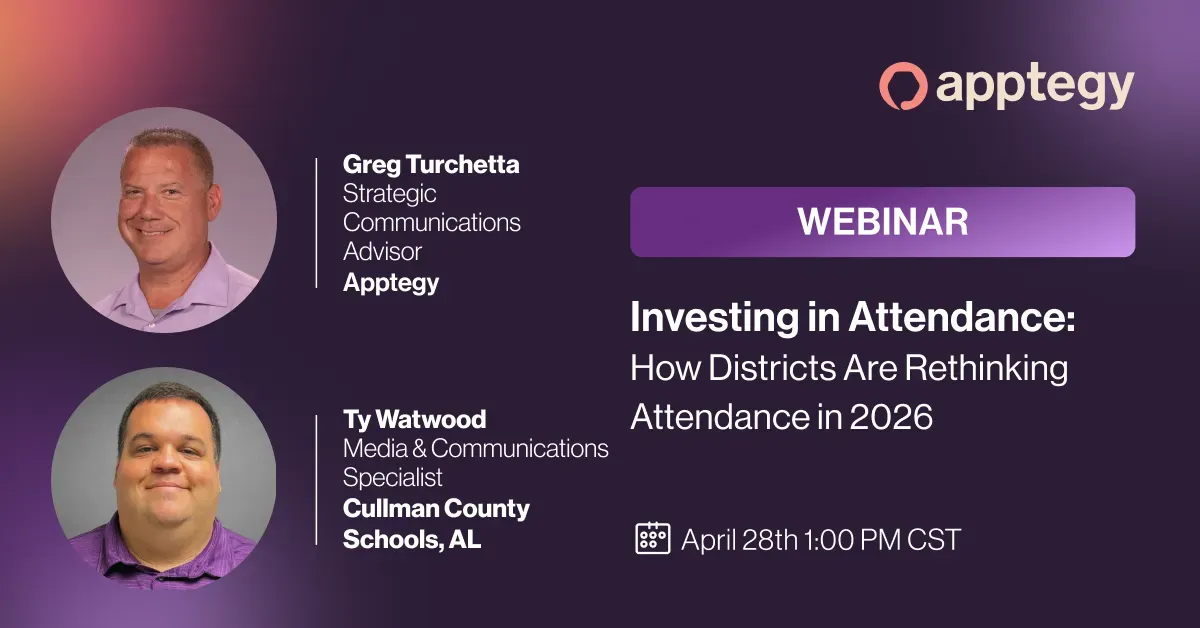
So what’s getting in the way? Join us for a district-led conversation on how attendance leaders are rethinking their approach—moving beyond one-way alerts and manual follow-up toward more proactive, scalable systems.
Related Resources
The Search for a Better Way to Communicate
How a 9,700-student Oklahoma district is replacing broken communication workflows with AI-powered attendance outreach — before chronic absenteeism takes hold.
6 Research-Supported Ways to Improve Attendance
Learn 6 research-supported strategies to improve school attendance and reduce chronic absenteeism—with tips to act earlier, at scale.
The Hidden 80%: How to Prevent Students from Becoming Chronically Absent
New research suggests the 10% chronic absenteeism threshold is already too late. While districts focus on students in crisis, most attendance systems miss preventing problems across the other 80% of student populations.
Transcript
Greg Turchetta: All right, so here we go. My name's Greg Turchetta, if we haven't met yet, I'm the Strategic Communications Advisor here at Apptegy. My district co-host will be Ty Watwood. We're hoping he's gonna drop in any moment.
Wait! He's literally dropping in any moment. Ty, how are you?
Greg Turchetta: Introduce yourself, sir. We're to the point of you introducing you.
Ty Watwood: Well, I am me.
Ty Watwood: I'm Ty, I work for Coleman County Schools. I am on the golf course today, because when I agreed to do this, my daughter was not playing in the state golf tournament, but now she is.
Ty Watwood: So, being the dedicated person I am to help Greg, I agreed to not cancel and have come into the clubhouse to do this call.
Greg Turchetta: Hey, breaking news, how'd she do?
Ty Watwood: She's still out there, and it's not going so well, so it's probably good that I left. She may do better.
Greg Turchetta: Maybe, maybe you're the good luck charm further away.
Greg Turchetta: Awesome. Well, Ty, thank you for making it here. Hey, listen, if you're here, in the chat, let us know, what is your role? Are you a comms person?
Are you an attendance person? Are you a principal, superintendent? And where you're joining us from.
Greg Turchetta: And we'll start to, kick those off. Emily said, Ty, that's amazing, what a good dad and a friend to me. She's absolutely right. Okay, so here we go.
Our goals today, as you're entering into the chat, we want to break down key strategies to proving attendance.
Greg Turchetta: We've got principals, excellent, principal from Michigan. We've got digital social media managers. We've got an assistant principal, yes, APs represent…
Greg Turchetta: We've got current communications directors, attention intervention specialists. I love this. Alright, so this is right up all of your allies. Teacher from Texas.
We got everything, Ty.
Ty Watwood: Alright.
Greg Turchetta: We even got data specialists, data stewards, another principal. Yes, okay. So our goals today break down key strategies to improve attendance. We're also going to explore where your systems are breaking down today, and then we're going to learn why and how one district, that guy right there, is investing in a new approach.
Greg Turchetta: And then we're going to discover how to shift from reactive process to proactive supports.
Greg Turchetta: And we're gonna get a real, practical, real-world perspective on what it takes to improve attendance at scale in today's environment. And listen, we get it, it's tough, right?
Greg Turchetta: So let's go. Quick poll.
Greg Turchetta: Where does attendance rank among your district priorities?
Greg Turchetta: I'm gonna guess it's awfully high, it's probably right behind academic outcomes and enrollment, or in some order there. But here's the trickier piece to this question, the follow-up. Where does attendance rank among your communication priorities?
Greg Turchetta: Let that simmer for a second.
Greg Turchetta: And we're gonna dive into more of that.
Greg Turchetta: Okay, so…
Greg Turchetta: Let's talk about today's research. Obviously, there's a lot of research that's gone into attendance, because in some states, attendance affects funding. Obviously, it affects student academic outcomes, but attendance improves when families feel connected, supported, and engaged, not blamed, right? Attendance work emphasizes that relationship building and positive communication are, of course, a foundation for stronger attendance.
Greg Turchetta: And the Institute of Education Science has found that targeted two-way text messages to families
Greg Turchetta: Reduce chronic absenteeism by up to 7.5 percentage points among students with prior attendance challenges, which, when you think about it, with today's family and digital natives, that makes sense, right? Two-way texting meets families where they are and gives them an easy, frictionless way to respond and engage
Greg Turchetta: and proactive communications around attendance. And that is a key theme today.
Greg Turchetta: One way versus two-way. We're gonna get back to that in a second. But recent research shows that students who become chronically absent are displaying warning signs well before they cross that threshold. And the best way to reduce chronic absenteeism rates is to prevent them, right?
That's the goal of what we're here to do.
Greg Turchetta: So, if we know what's proven to work, then why are attendance rates so low?
Greg Turchetta: And to answer this question, we're going to have to analyze the strategies… some new strategies, against our current systems and workflows, because
Greg Turchetta: Most of the people on this call, I think you're here because you realize there's… there's some blind spots, there's some issues with… and friction in this process. So let's dive into that.
Greg Turchetta: Strategy one, early communication. Research has proven that a key to improving attendance is early communication and having the deep context behind the absence. Yeah, we know the kid's missing, but do we know why?
Greg Turchetta: Do we know what context there is? And then that's where the intervention comes. But yet, today's systems, they're one way. One-way notification of absence, and if you're a parent, you're gonna notice that Johnny missed fourth period or missed the whole day.
Greg Turchetta: And that's it. There's no way for me to come back and question it, or provide context to it. We tracked that a student was absent and not why.
Greg Turchetta: How do you have an intervention if we can't find the patterns? And then the one-way systems create friction that makes sharing timely updates difficult.
Greg Turchetta: And we're gonna dive a little more into that in a second. Strategy two. We already talked about two-way texting. Listen, guys, we're in a… we're in a text world, right?
We're in a… we're in the parents want to know and need to know and communicate now world. That means it should be two-way, but our systems right now are one-way. We send the notification, and then we rely on notes and phone calls for follow-up.
Greg Turchetta: And we require our families to coordinate outreach and communicate in often unclear channels.
Greg Turchetta: Have you audited your procedures as from a parent's point of view of what it takes to send a note, to call and clarify an absence to get it excused?
Greg Turchetta: And systems today are not built to support two-way texting related to attendance.
Greg Turchetta: Strategy 3, earlier support.
Greg Turchetta: Systems today require manual report manipulation to identify trends. I can't tell you, I spent a lot of time working on case studies in the last couple weeks on this.
Greg Turchetta: And the attendance secretaries and the people that are doing this district attendance work, it's a manual labor job, right? They have to dig through all this data to start playing detective, principals as well, right? APs as well. How to find the patterns of what's going on.
In fact, one of the districts I talked to the other day said.
Greg Turchetta: They just found out now that back in February, one of their kids missed 3 straight days due to a busing issue.
Greg Turchetta: And as the district attendance chief said to me, that would have been much better to know back in February when we could have done something about it.
Greg Turchetta: But that puts a strain on your staff capacity for interventions because of that manual workload, and it forced districts to prioritize interventions to those that are already absent at risk.
Greg Turchetta: Now let's go to the parent point of view for a second.
Greg Turchetta: Because I want to, when we started doing this webinar, I said, let me go in and let me play parent. If I'm gonna go to your website, and I'm gonna come in and figure out, how do I report an absence? How do I get a note in? I went to some of the districts that had an AI chatbot, as you can see here, and I asked the question,
Greg Turchetta: How do I report an absence? And this one was pretty straightforward. It said you can fill out the form by providing necessary details
Greg Turchetta: Such as the email, date of absence, and an explanation for the absence. And then if you can… here's the schools, here's the link to get through, no problem.
Greg Turchetta: This is where it got a little more messy.
Greg Turchetta: Top left corner. To report an absence, parents have two options to submit a note. A signed, handwritten note from the parent, how, and an email or an email note sent to the school's attendant's email address.
Greg Turchetta: Okay.
Greg Turchetta: bottom left, you can fill out the form. Again, with the school, that's great, but the middle one. To report your child's absence, parents or legal guardians are required to notify the school within 24 hours of the absence by telephone call or a written note that you can send to school with your child. That sounds like it's from the 90s.
Greg Turchetta: Right? I mean, backpack journalism, using the kids to transport information back and forth, we've proven over and over is an outdated, tough system to use. But here it is, it still exists. Order the right, going into your student information system and going to your Skyward account, that works well, too.
Greg Turchetta: So, what's your current reality? If I was to come to your site right now, how hard would it be for me as a parent to engage and give you the answers you need, and for me as the parent to feel like we're on the same team? So, if you audit your current workflow, how long does it take to get a real answer?
Greg Turchetta: What's your biggest delays? Is that the outreach? Is it the follow-up? Is it the documentation?
Greg Turchetta: And then I want you to ask one question. Are we built to respond early or react late?
Greg Turchetta: And that's hard, because… If you react late, it's tough to have an intervention.
Greg Turchetta: All right, Ty, let's talk about your district, Coleman County Schools, Alabama. Ty, looking at the data here, aerated district, 30 schools, 10,000 students. Your absenteeism rate seems to be going the right way, going down since COVID, right? And you're below the average, so why is attendance such a top priority for you guys?
Ty Watwood: I think you gotta look, too, and I know all… everyone on the call can share their frustrations with COVID and attendance.
Ty Watwood: We're still not where we want to be. We're still not where we were pre-COVID. And it's, it's becoming harder and harder to get to where we want to be.
Ty Watwood: So, you know, 10% of,
Ty Watwood: 10,000 is easy math. That's 1,000 kids.
Ty Watwood: That are chronically absent in our school district.
Ty Watwood: And that's… that's just too much. There's still work to be done, and we're not gonna…
Ty Watwood: gonna give up until we, you know, can lower that number. Could it be zero? No, we know that, but it can be a lot less than 1,000.
Greg Turchetta: Of the strategies we were just talking about, did any of them stand out as something that you guys at Coleman have seen? Yeah, we're frustrated by that, too?
Ty Watwood: Thankfully, we're not doing the, the, you know, pack-back journalism approach anymore, but the,
Ty Watwood: You know, I think the…
Ty Watwood: nobody wants to get this into a truancy-related thing, and that's kind of where a lot of these end up, in Alabama, and
Ty Watwood: You know, you know, We send early warning notices,
Ty Watwood: Those do go in electronically. They…
Ty Watwood: But, you know, we're out of ideas, we're out of ideas with what can we do proactively to
Ty Watwood: even get to that point, so I really feel like
Ty Watwood: you know, we can utilize some of these tools to help lower that number and get there, and get what we want to get without having to, you know, get the court involved. And that, you know, nobody has time to do that. We don't have time, we don't want to mess with it.
Ty Watwood: But sometimes you have to, but we can lower that.
Ty Watwood: That number significantly, that's our ultimate goal.
Greg Turchetta: Absolutely. All right, so let's talk about that. Let's talk about the shift that, Ty, you're about to make, and we're going to dive into that in a second here, but we have to rethink how we engage our families, right? Ty's exactly right.
We don't want to be taking kids and families to court, right? That changes the relationship completely right there. How do we get to the solution prior to that, right?
Greg Turchetta: step one, move from one-way alerts to two-way outreach, and I'm guessing, Ty, that's what got you interested, was the two-way component of it.
Greg Turchetta: Yeah. And then move from tracking to understanding. If you could have AI-powered guided messaging to go deeper and have conversations on your behalf, with your parents, to find the root cause of an absence, that has to bring value. Am I… am I right?
Those insights have to share value.
Ty Watwood: I mean, you're basically, you know, you've got a two-way communications model all of a sudden now, where the parents know, hey, we're approachable here, you know? You got an announcement's coming, just tell us, you know, shoot us a text in advance. I mean, it's game-changing compared to what we've done in the past.
Greg Turchetta: Absolutely. In the districts that are making this shift, they're saying there's an increased staff capacity to be proactive now. All that manual labor goes away, and that follows to those automated workflows that increase the staff capacity to actually be in contact with the parents, saying, how do we help you? How do we get over that transportation issue?
How do we get over the issue if your child was sick and needs some kind of supports, right?
Greg Turchetta: And if we can act earlier with actionable insights, that leaves that stagnant data report behind, and we have real-time insights. Like the example I used.
Greg Turchetta: from the district in Oklahoma I was talking to you about. Finding things out two months later gives you no power. That data is absolutely useless. It's more of a post-mortem than it is proactive in identifying patterns and ensuring effective supports.
Greg Turchetta: let's… let's dive into where are we going with this, okay? So right now, every system
Greg Turchetta: that you're using out there is a one-way push that says a student was marked absent in class or for the day, and a message goes to the parents, right? And that's where it ends.
Greg Turchetta: No, not anymore. Because now,
Greg Turchetta: Attendance Pro automates that conversation, and then it sends out… families receive a text in their preferred language, and they can reply immediately and seamlessly in their own language.
Greg Turchetta: So now, we've eliminated any accessibility issue, right? The AI attendance assistant will use guided follow-up prompts to capture more details, such as the severity of the illness or why transportation was difficult, and then will handle the coding and the documentation automatically. How much time did that just save?
Greg Turchetta: And then additionally, it can escalate any high-risk or special use cases
Greg Turchetta: to the people that need it, right? For immediate support. And it also can unearth those early patterns and trends by school district and student.
Greg Turchetta: as a parent, I can tell you, there were times when I got a message from the school that said, are you aware that Joseph has missed 8 days? And I was not aware it had gotten to 8 days, right? So, from the parent end of this, too, these are insights that will help make sure this is on their radar, and that's huge, too.
Greg Turchetta: So, that's… that's what… that's the product we're talking about, is Attendance Pro that does this, and it does it what no other product can do.
Greg Turchetta: So, Ty, to that point, why did you select Attendance Pro?
Ty Watwood: No, I mean, I think,
Ty Watwood: you know, Apptegy, historically, you know, we went from having nothing to having,
Ty Watwood: You know, one-way communication for absences, which was a game-changer when it came out, you know, several years ago.
Ty Watwood: why not take that a step further? And we're like, well, you know, if this has worked so well, notifying parents of absences this way, what if we can, you know, go two way? What if they can respond with a doctor's note?
Ty Watwood: you know, that was kind of a, you know, the next logical step in a process to try to make this better. And so, really a simple, easy decision.
Greg Turchetta: As you start to monitor the data that's coming in, how are you going to determine this to be successful?
Ty Watwood: You know, I think,
Ty Watwood: You know, initially, we as a district are going to, take that data, see where it matches with our trends.
Ty Watwood: you know, say the previous 12 to 18 months per school, go through, see the, you know, the number of schools and parents that are, that are utilizing it. I think,
Ty Watwood: you know, through our testing, our administrators are totally on board with it, which is rare anytime you implement something new. But they, I think, can… I think the frustration of having to deal with attendance
Ty Watwood: Anything we can do in that area to improve an issue.
Ty Watwood: such as that is going to be welcomed pretty quickly, and, and therefore, I'm at 100%, acceptance rate on,
Ty Watwood: on, the folks that I have that are, that are, you know, implementing this for me. So, man, I think it's gonna be, be a game changer for us, and, you know, I really think the, I think we're gonna see some improvement.
Greg Turchetta: One of the things, and I was talking to a district administrative chief this week, he said he's excited as the data starts to pour in from these two-way conversations.
Greg Turchetta: Because it now is new data that's going to be in the hands of more conversations, and he pointed to IEP meetings, he pointed to attendance meetings with parents, it's… now we can say you've received 10 text messages saying your child was missing, here's the patterns, here's all the messaging we've done, and there's no surprises. Is that something you could see at the school and district level, and Coleman being a big…
Greg Turchetta: resource as well.
Ty Watwood: Absolutely. And I'll tell you something else. Okay, so I got two kids in our school system. One of them is a very responsible kid, one of them, yeah, is on the fence on that, but, you know,
Ty Watwood: just the mere fact of knowing that if I've got one that's absent, that I can…
Ty Watwood: snap a pic of a doctor's note, send it in, and then it's done. I don't have to worry about, did this note make it? Or, you know, in cases in the past where, you know, several days or weeks later, we start getting questioned about when are the, you know, where did you have notes? I'm like, yeah, I had a note, but I sent it to my kid, and I don't know why they brought it.
Ty Watwood: that's all gone, and so I think it's gonna clean that up from that perspective, but
Ty Watwood: You know, I… I think it's gonna be fantastic.
Greg Turchetta: Awesome, absolutely.
Greg Turchetta: All right, so it's called Attendance Pro. Here's your first look at what it looks like behind the scenes. You've heard me talk about the two-way real-time SMS conversations, and you heard Ty just refer to, if a parent's at home with a phone, they could be at the doctor's office, right? And that… everybody's got to get the doctor's note.
They take a picture of it, they submit it as a text message, the system says, thank you so much for sending in this documentation, game over.
Greg Turchetta: Right? The job is done at that point. End-to-end workflow automation. You can see, you can set it up, you want 15 days, set a threshold at 15 absences.
Greg Turchetta: consecutive or not, and then how frequently do you want these reports being run, right? And it'll do all of that. And then that last box, obviously equally as important, that early warning insight from real family responses. You can see it's labeling them severe, chronic, at-risk, moderate, satisfactory, in data tables that you could pull up in a principal meeting and show and say, okay, here's our school trends, here's what we've got going on, right?
Actionable insights and time to do something
Greg Turchetta: with…
Greg Turchetta: Okay, so stop chasing attendance and start solving it with Attendance Pro. We talked about the AI-powered text message, early insights, the automatic coding. If you want to see it, you want to schedule time to see it, you can scan the QR code right there, apptegy.com/attendance.
Greg Turchetta: And that will take you to where you can get a much deeper look than the taste we gave you today.
Greg Turchetta: If anybody has any questions or any follow-ups, want to ask Ty anything, now is the time to do it. It's a nice, brief webinar, but I just wanted to give you an overview. We're excited about it. We're excited about something that can impact student outcomes from a communication point of view.
We're excited…
Greg Turchetta: About the idea that it makes your jobs easier. To my principals, my APs, my attendance people on the call, I'm a former comms chief, I know how hard it is to do what you do. And anytime we, as a company, can do something that takes something off your plate and makes room for other things and makes the process better, we're really excited about it. So we're excited to bring this to the market, show it to you, get it, as you can see from Ty.
Ty, last thoughts on
Greg Turchetta: I'm getting this in your hands.
Ty Watwood: I'll tell you one thing that I didn't… wasn't aware of, when we first started implementing versus now is how the, there is a dedicated phone number for your school. So you've got the, you know.
Ty Watwood: XYZ Middle School attendance phone number, and…
Ty Watwood: Parents can even, and this is… don't laugh, but they can actually be proactive here and send you your, excuse in advance, and it'll… the system will go ahead and pre-prepare and have it ready to go for… if they're going to be out on Friday this week, it'll go ahead and mark them ahead of time if the parent lets you know
Ty Watwood: So… it, it's, it's, it's, it's a game changer, guys.
Greg Turchetta: Couple questions coming through…
Ty Watwood: Question about current SIS, if you want to answer that.
Greg Turchetta: Yes, it will, it's obviously reading from that, to get the information of who to talk to.
Greg Turchetta: The other one was, did it… did you say it gives parents a report and or a warning when the student absence is excessive? Yes, it's gonna be… it's gonna flag it and tell them it's 5 app… whatever thresholds you set it to, but yes, it's going to give actionable insights to the parent and to you guys as the user.
Ty Watwood: Yeah, and it's customizable, like you said, and I had to provide our attendance policy and attendance codes so they could customize the agent for my school system.
Greg Turchetta: Awesome. Anybody else have any other questions? Like I said, that's a very surface-level touch of this. We have product experts that would love to give you a deep dive on this that we can schedule calls with for you to see it.
It is a game-changing product. Like I said, it's the only two-way communication tool that's out there for attendance right now.
Greg Turchetta: We worked really hard to build this because we knew this was a need. This was a need from districts we heard across the country that we have to solve attendance.
Greg Turchetta: Trent says, does it connect and report in PowerSchool also to avoid typing it in by staff? That is one I'd have to have our product experts talk to you about, Trent, because I don't get that deep into the integration process. But, definitely a question you can schedule a conversation with.
Greg Turchetta: All right, thank you guys. Appreciate your time today. We didn't go the full hour, but like I said, just wanted to get this in front of you and let you see what's possible. So thank you guys for joining us.
Ty, thank you for taking time off of the golf course. I hope when you respond back, your daughter… maybe situations improved. If not, it's an amazing experience either way.
Ty Watwood: That's right. We're not in class, and it's excused. We put it in Attendance Pro, see? It's, you know, school activity.
Greg Turchetta: There you go, you got a note for that?
Ty Watwood: There you go.
Greg Turchetta: Thank you, guys. Have a great day.
Greg Turchetta: Talk soon.
Ty Watwood: Thanks. Take care, guys.