/)
In the article ahead, Dr. Richard "Dicky" Barlow—longtime superintendent of Mountain Brook Schools in Alabama and 2023 Alabama Superintendent of the Year—explains how a Savannah Bananas game and books like Unreasonable Hospitality inspired him to build a culture of hospitality among staff, students and families. His philosophy is simple: People who feel seen, heard and valued will pass that feeling on to everyone around them.
Dr. Richard Barlow, the longtime superintendent of Mountain Brook Schools in Alabama, would have you know he’s just a regular guy. Alabama’s 2023 Superintendent of the Year doesn’t go by “Dr. Barlow”; he goes by “Dicky.” If you ask him about his achievements, he is quick to credit friends and colleagues for his successes. And if you need to get a hold of him, his email and telephone number aren’t gatekept—they’re both listed on the district website.
The down-to-earth super with a gentle Southern twang naturally puts people at ease. But a chance encounter with a dancing baseball team and some choice books have persuaded Barlow to put more intention into how he and his staff treat one another—and their entire community. Now, making people feel comfortable isn’t just a character trait; it’s an operational priority. “When parents come in, we want them to feel like they belong,” Barlow says. “To think, ‘My child belongs here, and I’m welcome here, too.’” While the employees at Mountain Brook were already doing a pretty good job at this, Barlow knew they could all do even better.
The Path to Mountain Brook
Growing up, Barlow was a talented athlete. He played basketball at Georgia State University, and his team even went head-to-head with young Michael Jordan’s University of North Carolina Tar Heels. Though he had been planning to major in business, playing at Georgia State ended up completely changing the course of Barlow’s career—just not in the way you’d expect. While he describes his college basketball coach as a genius who innovated the game, Barlow also recalls that he did not always put his players first. During a particularly tense season, the entire team roster walked out in protest. Barlow walked away from it with a whole new future. He decided to become a teacher and coach to prove “you can treat people with dignity and honor and still get the best out of them,” he says.
Barlow earned his science and physical education certifications and got to work. But after several years teaching and coaching basketball, he was no longer sure he belonged in education. After stepping away from his job, he received a call from a former colleague offering him a brand-new role as a student intervention specialist in Georgia’s Gwinnett County Public Schools. “And I said, ‘What's that?’” recalls Barlow. “Because back then that wasn't a title that anybody used. He kind of made it up.” Needless to say, he was intrigued.
The new student intervention specialist would be tasked with identifying and helping the kids falling through the cracks in a massive high school of nearly 3,000 students. Barlow learned that even students who appeared to have their lives together were sometimes dealing with serious underlying problems, such as drug or alcohol issues. “It was transformational for me,” he says. “They don’t tell you in college that in order to be a great teacher, you really have to know students and what makes them tick. Those four years made me realize you have to look behind what students wear, what they drive or how they act.” It taught him that “truly knowing” a student and understanding their life circumstances was essential to helping them succeed. The lesson would stick with him for the rest of his career.
Barlow eventually became an assistant principal in the district. Two years later, a Gwinnett County colleague urged Barlow to follow him to his new post: Mountain Brook Schools outside Birmingham, Alabama. Barlow didn’t really want to leave his Atlanta life behind, but one visit to the idyllic little town completely changed his mind. In 1996, Barlow accepted the assistant principal position at Mountain Brook High School, where he would stay for the next 12 years.
The Crossover to Central Office
Barlow’s transition to the central office was again a result of one of his many supporters asking him to sub in. In 2008, now a principal, he sat down for what he thought would be a casual conversation with Mountain Brook’s superintendent, Dr. Charles Mason. The super told Barlow he was planning to retire in a couple of years and asked the young principal about his career plans. “I was completely caught off guard, so I made something up,” Barlow says. “I said I would like to be a personnel director because I enjoyed people, and my stretch goal would be becoming a superintendent in a school district not named Mountain Brook.”
It wasn’t that Barlow wanted to leave Mountain Brook, but he assumed he was underqualified to lead such an impressive district. But as he recounts, Mason told him, “You understand the culture of this school and this community, and people trust you and care for you. That's more important than knowing how to run a school system.” Mason concocted a plan to move Barlow to the central office, where he could continue doing his job and shadow the superintendent at the same time. A year later, when the school board began their national superintendent search, they did so with Barlow as the candidate to beat. The rest, as they say, is history. The 2025-26 school year marked Barlow’s 17th as superintendent of Mountain Brook Schools.
Under Barlow’s leadership, all six of the district’s schools have been named National Blue Ribbon Schools. Academically, Mountain Brook High School has consistently ranked in the top 1% of high schools nationally; it also has one of the highest-performing public high school athletic programs in the U.S. To facilitate his students’ growth, Barlow has also overseen significant capital improvements during his tenure. Following a buildings audit in 2018, the district passed a tax increase and has spent roughly $74 million improving every school. The junior high and high school buildings have seen the most significant changes; both were completely renovated, and between them, 60 new classrooms have been created. To use some of Barlow’s characteristic humility, you could say he’s been doing alright.
Witnessing a Hospitality Home Run
Barlow's focus on customer service was first sparked through his involvement with a superintendents’ network called the Schlechty Center, which routinely studies outside organizations to see what school administrators can learn from them. A few years ago, the group visited the Savannah College of Art and Design on a learning trip. While there, they also attended a Savannah Bananas baseball game.
If you’re not familiar with them, the Savannah Bananas are an amateur baseball team that was formed by Jesse Cole in 2016. The former general manager of a collegiate summer league team, Cole became obsessed with creating the best experience possible for Bananas fans—starting long before they arrive at the stadium.
Now, the organization sends fans a thank-you email the day after they purchase tickets to a game. A week out, they send ticket holders a curated Spotify playlist to get them pumped. On game day, the team greets visitors in the parking lot before they enter. Cole is there, too, in a bright yellow tuxedo and top hat. And those tickets? They’re all-inclusive—once you enter the stadium, you don’t have to pull out your wallet to buy food and beverages. The team doesn’t just play baseball on the field, either; they also do choreographed dance routines. And between every inning, they keep the crowd engaged with things like cute baby contests or senior citizen cheerleading squads.
Cole’s focus on the fan experience has paid off. There is now a yearslong waitlist to see a Savannah Bananas game, and Cole has spun off a whole new league of teams inspired by the Bananas. “His willingness to ask, ‘Are we doing baseball wrong?’ prompted me to ask myself, ‘Are we doing school wrong, or could we do school more right?’” says Barlow. “It made us think about things that we could do outside of the classroom that would enhance the experience.”
After returning home from Savannah, he couldn’t stop talking about his newfound passion for customer service. Someone recommended the book Unreasonable Hospitality by Will Guidara, which echoed what Barlow learned about “truly knowing” students as an intervention specialist. He asked his central office leadership team to read it, too, and together they started having conversations about what a hospitable environment would actually look like at the district. They agreed it would require making their community feel like Mountain Brook Schools was a home away from home, where everyone would feel seen, heard and valued.
Staff First
Barlow realized that to truly make his district more hospitable, he had to make his employees feel good first. But when he asked employees directly what kind of environment they needed to do their best work, he wouldn’t always get honest and reflective answers. Another book, Everybody Matters by Bob Chapman and Raj Sisodia, inspired him to ask the question a different way. “We started asking employees to think of the person that they love the most in life right now. What would you want their employer to be like?” he says. Asking staff members about their loved ones rather than themselves opened up deeper answers.
“My son is getting ready to graduate from college, so I asked myself the same question,” says Barlow. “I want him to work for an organization that says, ‘We see you and want to help you. We want to pour into you, and we also want to hold you accountable. We're going to do everything in our power to make you better.’” So those are the conversations that the superintendent and his team have been initiating over the last school year in order to foster an engaging and encouraging environment for staff. Of course, the hope is that staff members who feel like they truly belong at Mountain Brook will make students and families feel like they belong, too.
In line with this, new teacher orientation week has become New Member Institute, a week that ensures new hires understand and align with Mountain Brook’s values. “We don't want somebody coming into our district who doesn't believe what we believe,” says Barlow. “So our orientation is not about their benefit package and how to sign up for technology—we do all that stuff beforehand. We bring them in for three or four days and say, ‘Here's what we believe. And not only do we believe it for our students, but we believe it for you, too.’”
After COVID, Barlow noticed that some students—and even teachers—had missed out on building necessary interpersonal skills. “We can’t teach people how to be the best teacher, the best custodian, the best coach,” says Barlow, “if we're not talking about how to listen, how to sit down and talk to somebody for a few minutes and connect with them. Everything starts with relationships.” So that’s what Barlow started to do: just sit down and talk with his employees for a few minutes.
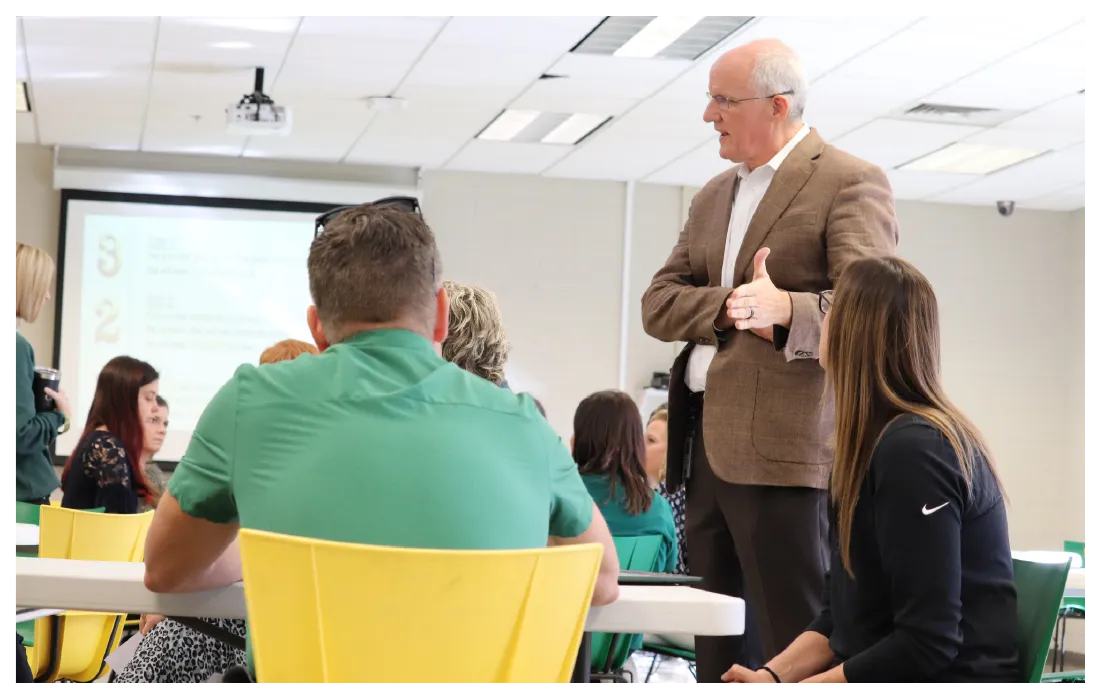
COVID didn’t just create a deficit in relationship-building skills; it also led to higher-than-usual turnover. Toward the end of the pandemic, Barlow realized nearly 50% of Mountain Brook’s staff had been with the district for less than three years, and he didn’t recognize all of these new faces. “I didn't know what they looked like, I didn't know what their families were like, and that's not okay,” says Barlow. So he began to visit schools about twice a week in a bid to meet with everybody in the school district for 15 minutes each. “At first, people would come in with a little list of things they wanted to talk to me about. I tried to make it clear that I was just coming to talk to them as a person, not as an employer,” he says. Now, part of the New Member Institute is, of course, sitting down with Barlow and shooting the breeze.
This is important to Barlow—not every conversation at work has to be about work. He hopes his employees’ lives are much bigger than their occupations. That’s why the district also emphasizes the importance of a healthy work-life balance during New Member Institute. “You can't just give everything to your job. If you do, then in six months to three years, you're going to be no good to us, and you're going to be no good to yourself,” he says.
Assessing True Engagement
“People should feel like they're seen, they're heard, they're valued. If that's a mathematical equation, that equals being known,” Barlow says. But making everyone in your school community feel known is easier said than done. And how would you even go about measuring success?
To that end, Barlow adopted a quadrant model used by marriage counselors to keep spouses accountable for their behavior toward each other, adapting it to his employees’ circumstances. On it, “Quality Practice” is measured along the vertical axis while “Hospitality” is measured along the horizontal axis. Here, quality practice refers to the core competencies and expectations of running a school, whether that means teachers improving academic scores, custodians knowing how to properly clean a bathroom, or front office staff following standard procedures. Hospitality refers to how employees are endeavoring to make people feel seen, heard, valued and ultimately known.
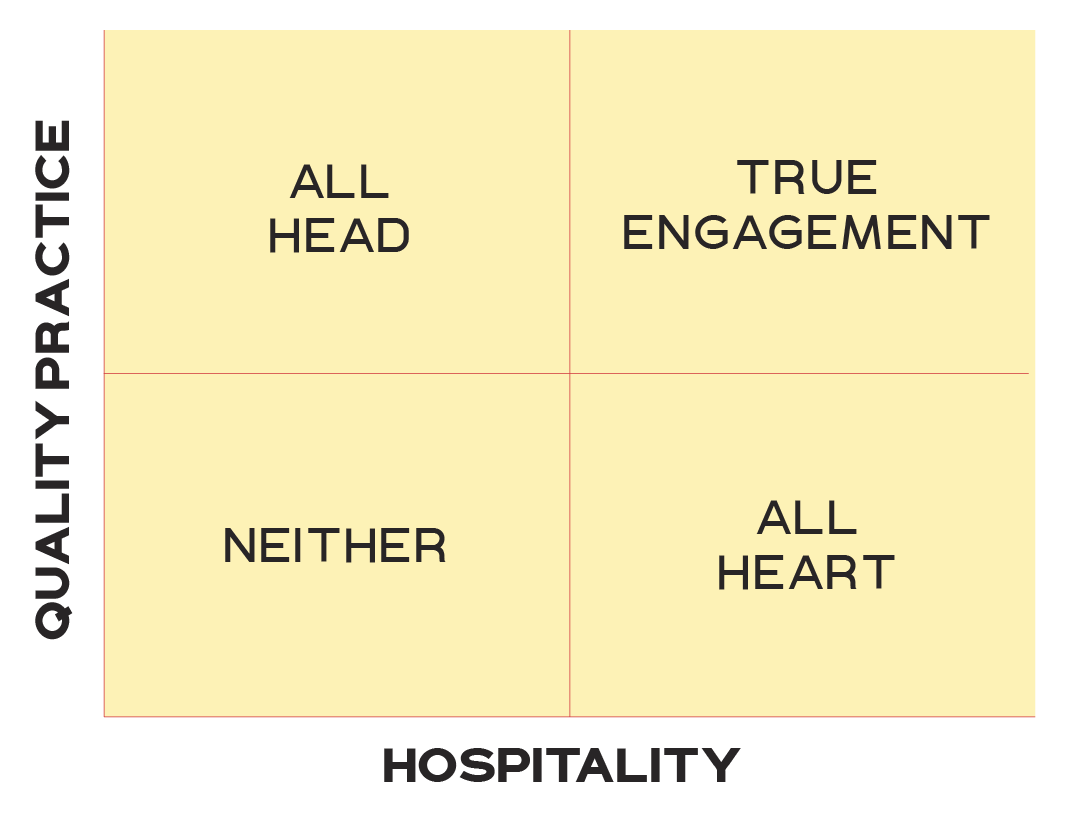 Along these axes four distinct quads are formed. The so-called "elitist" quad in the upper left corner is high on quality practice but low on hospitality. These individuals deliver great results and possess high technical skill, but do not focus on personally connecting with others. New hires often make up the bulk of the low quality practice / high hospitality quad in the lower right corner. They are enthusiastic about their jobs and love the kids, but maybe haven't quite mastered the professional skills of teaching yet. Barlow jokes the low quality practice / low hospitality quad in the lower left corner is the “fired" quadrant because it describes people who lack both technical skills and care.
Finally, true engagement, the high quality practice / high hospitality quad in the upper right corner, is the ultimate goal. “We try to make the point that this is dynamic,” Barlow says. “Just today, I could put myself in every one of those quadrants right there. There are times today where I was probably elitist, just spitting out the information and doing the best I could. There were probably a few moments today that I needed to be fired. So it's not that these things are wrong or right, but that true engagement is where we want to be.”
When teachers are operating from the true engagement quad, Barlow argues, it benefits students more than taking the elitist approach. A teacher who is truly engaged is genuinely invested in both the lesson and the outcome.
The Way Life Should Be
While Barlow’s focus on hospitality has mostly centered around staff so far, it’s all with a larger vision in mind. “One of my friends said to me once, ‘What would you rather do? Would you rather go to a Six Flags amusement park with strangers and ride the rides, or sit behind the Shell station on a Friday night with three of your best friends?’” Barlow recounts.
If you ask him, roller coasters can’t compete with friendship. He would bet most people feel the same way. “That's what we're trying to create—the Shell station,” he says. He means a place people want to spend time to see the people they care about. A place where meaningful connections bring joy. “What if we build a school environment where if somebody is down, two or three people say, ‘Hey. I noticed you've kind of been down the last couple of days. Want to talk about it?’” says Barlow. That’s what he wants to build at Mountain Brook Schools—one where staff take care of kids and where kids take care of one another.
That doesn’t mean Mountain Brook Schools are devoid of amusement, though—they’re actually a lot more fun than a gas station parking lot. Inspired by the Savannah Bananas, the schools are thinking hard about how best to engage students and the community in the moments before, between and after class. Mountain Brook Junior High is leading the charge. Every day, their school resource officer makes sure to high-five every single child who walks through the front doors. On special days, staff members wait in front of the school to hand out donuts to surprised parents. And inside, the traditional bell has been replaced with Spotify playlists to keep kids energized between classes. The switch is engaging families, too; parent groups have jumped at the chance to create playlists for their kids. But they can’t touch the Tuesday playlist—because every Tuesday is Taylor Swift Tuesday at Mountain Brook Junior High.
At Barlow’s behest, Mountain Brook High School is starting to reinstate fun community events such as student-faculty basketball games, which had previously been cut to maximize academic time. After all, Barlow knows all about the social benefits of playing on a basketball team. What students lose in homework time that day, they gain in communication skills, confidence and a sense of community.
Ultimately, Barlow believes hospitality can do more than just make employees and kids happier; he believes it can make them safer. Employees who feel seen, heard and valued make students feel the same way. Students who feel seen, heard and valued don’t lash out against people they love. That extends to the families, too. “If we all do these things, then not only will students feel really good about coming to school, but parents will feel really good about their kids being in school. And they will feel like they're welcome here, too,” muses Barlow. “Maybe they’ll think this is the way life should be. We should talk to one another. We should trust one another.” That sounds like pretty reasonable hospitality to us.
/)
/)