/)
In this article, you'll learn how two districts—Dalton Public Schools in Georgia and Broken Arrow Public Schools in Oklahoma—are using internal hospitality to boost teacher retention. From Dalton's wrestling-themed staff convocation and partnership with Ford of Dalton to Broken Arrow's on-site daycare and biweekly staff shoutout videos, the approach has helped both districts post retention rates well above state and national averages.
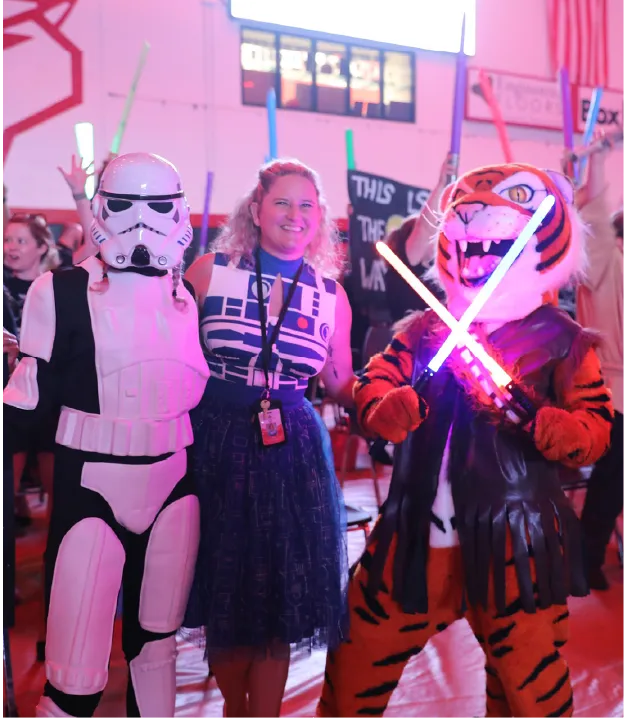
Minions, Star Wars favorites and professional wrestling icons fill the arena with energy. An emcee dressed as Dwayne "The Rock" Johnson presides over the crowd from the center of a wrestling ring. No, this isn’t Friday night on “WWE SmackDown!”—it’s a scene from Dalton Public Schools' 2025-26 employee convocation.
Now picture this: glow sticks light up the gym and school spirit takes center stage. Staff members from across the Georgia district perform choreographed dances and skits. Elementary and secondary school spirit champions are presented with championship wrestling belts. “We really wanted it to be a pep rally for the entire year,” says Dalton’s Executive Director of Communications Kendra Pannell about the high-energy event. But creating an unorthodox staff convocation is just one of many steps the district is taking to engage—and retain—employees.
Why Internal Hospitality Matters
When we talk about hospitality, we often think of it in terms of outward-facing service that we provide customers. In K-12 education, those “customers” are usually students, families and community stakeholders. But true hospitality begins with how a district treats its own staff. If staff are treated poorly, that treatment trickles down to the students. If staff are valued and appreciated, that also trickles down. That has certainly been the case in the private sector, where the relationship between high employee and customer satisfaction is known as the "satisfaction mirror."
It’s not simply a matter of teachers’ good moods rubbing off on kids, though. While students enjoy strong relationships with many teachers and staff, families interact with them far less often. That means it only takes one interaction with a school employee to change how a parent feels about a district—for better or worse. If you want to ensure the best possible experience for external stakeholders, you have to turn hospitality inside out and focus on employees first.
But the ripple effect of internal hospitality goes far beyond single interactions. In SchoolCEO’s original research study “What Teachers Want,” respondents ranked “school culture” as one of the most important factors in their decision to apply for a teaching job—second only to “geographical location.” In open responses, the word “culture” actually appeared more times than “salary,” “support” or “benefits.” Clearly, a positive company culture attracts more applicants.
But the best recruitment strategy of all time is retention. Let’s face it: Hiring a new teacher is more expensive than retaining one—and not just financially. It costs time to find candidates, time to train them, time to connect with them. Higher teacher retention rates support relationship-building and educational continuity for students.
This is where good internal hospitality can make the biggest difference to your district. If staff's needs aren't being met, they can't excel in their roles or serve students well—and you might even have a high teacher turnover rate to show for it. By changing the focus to internal care, districts like Dalton are seeing major cultural shifts.
How to Retain Staff Through Hospitality
Not surprisingly, Dalton Public Schools enjoys an 89% teacher retention rate, scoring favorably against state and national averages. But Dalton is not the only K-12 district in the nation showing their staff hospitality and reaping retention benefits. Seven hundred miles away in Oklahoma, Broken Arrow Public Schools’ current teacher retention rate is roughly 85%—well above the state average. “Even people that have left, a lot have come back because they miss the interaction,” says Broken Arrow Superintendent Chuck Perry. “Good people that keep you motivated and challenge you to be your best at all times—that's what we're built around.”
So how do these two districts achieve their high retention rates? And how can you achieve something similar? Let’s take a look.
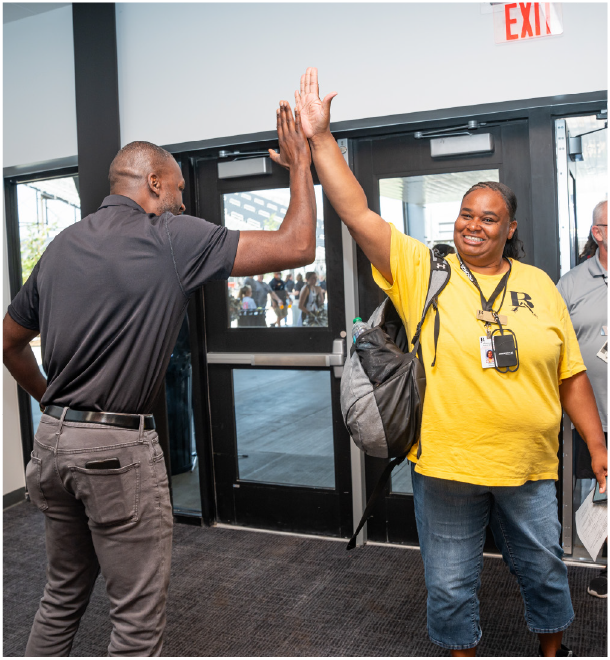 Staff recognition is a must-have, not a nice-to-have.
Dalton Public Schools Superintendent Dr. Steven Craft says money is not normally the reason people leave jobs. “A lot of times, it is about the culture and the environment they experience every day,” he says. “Are they feeling supported? Are they being communicated to? Are they being shown appreciation?” That part—showing them appreciation—is exactly what Dalton’s convocation does. “We roll out plans for the year ahead, but we also highlight our successes,” says Craft. “We talk about our gains from the previous year.” That includes awarding those championship wrestling belts to the school spirit champions, giving each winning school a highly visible symbol of pride to display throughout the year.
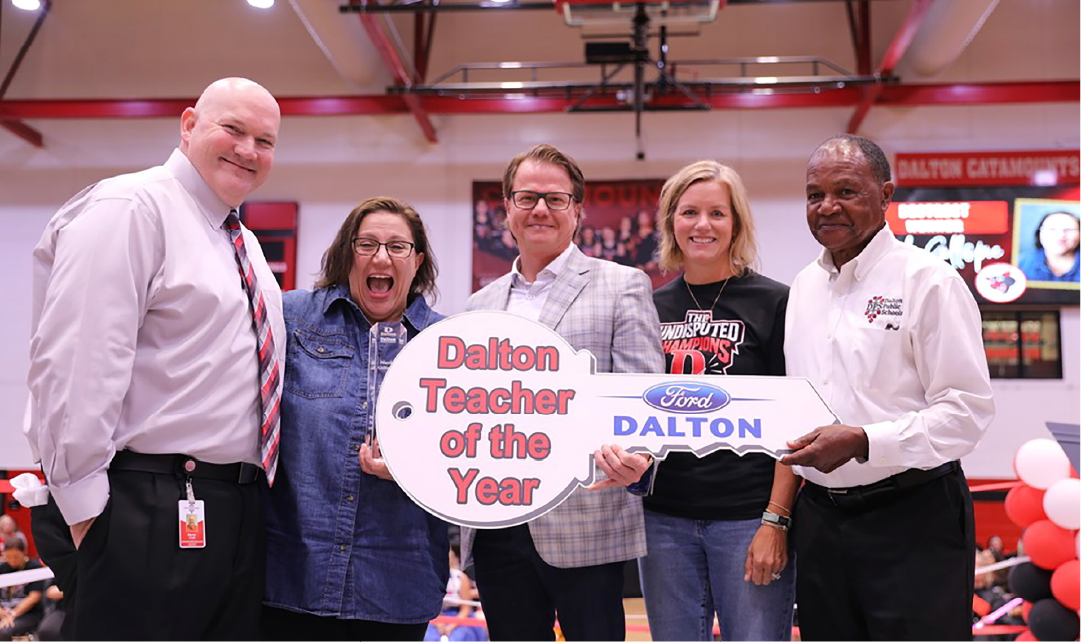
For many years, Dalton Public Schools has partnered with Ford of Dalton to celebrate the District Teacher of the Year. Prior to the announcement each year, a brand-new Ford vehicle is placed on display, building excitement for one of the district’s most meaningful recognitions. When award day comes, Ford of Dalton presents the District Teacher of the Year with a free one-year lease on the car. It's more than a generous gift—it's a visual reminder to everyone who sees the winner in it: “This is the Dalton Public Schools Teacher of the Year.”
 But you don’t have to give away a new car to make employees feel valued. Dalton’s communications team celebrates the impact teachers and staff have on students through its “Leave Your Mark” campaign, which shines a spotlight on employee stories across social media, printed materials and a series of videos. “We’re constantly reminded of the mark our employees leave on students—and of the mark those students will one day leave on the world, because they are the future,” says Pannell. “We know our impact extends beyond academics to the meaningful relationships our teachers and staff build with students every day.”
The celebration continues throughout the year with multiple recognition programs designed to spotlight employees who go above and beyond. Four times annually, Craft hosts a breakfast honoring a teacher and classified staff member from each school, each nominated by their principal for making an exceptional difference in their school community. Employees are also recognized through the district’s monthly Game Ball program, where staff members nominate colleagues who exemplify excellence. After personally reviewing the nominations, Craft surprises selected recipients with a Game Ball during district administrative team meetings, creating memorable moments that celebrate the people who make Dalton Public Schools special.
At Broken Arrow, Perry records biweekly videos for his employees highlighting staff members’ specialties and achievements. For instance, one video tells the personal story of a Native American warehouse worker who is an award-winning painter in their spare time. Others spotlight teachers doing unique lessons in their classrooms. “It doesn't always have to be this huge phenomenal thing,” says Perry. “Let’s just keep talking about the good things, because there's so many negative things from outside. You've got to combat that in some way.” Giving his staff a moment to shine—and giving their coworkers a peek into their lives—boosts staff morale without breaking the bank.
Support doesn’t have to be monetary.
The fact is, money doesn’t grow on trees—so district leaders have to get creative to make jobs more desirable for candidates. Partnerships with local businesses, such as the one Dalton formed with their local Ford dealership, are a great avenue for providing additional benefits to teachers.
At Broken Arrow, Perry started with his staff’s biggest pain points, then got to work creating programs to address them. For instance, many district employees have small children, and the cost of putting those children into daycare can be enormous. To offset some of that cost, the district created “Tiny Tigers Learning Center—a lower-cost daycare for employees,” he says. The state-of-the-art facility is equipped with live-feed cameras so employees can check up on their kiddos any time of day. That affordability paired with the peace of mind it provides has attracted more talent to the district. “A lot of teachers have made the choice to be in Broken Arrow because of it,” Perry says.
But Perry didn’t stop there. Realizing that students with severe, unchecked behavioral issues drive teachers away, Broken Arrow created the Tiger Connect program to move highly disruptive K-5 students to an off-site environment for at least six weeks. Rather than being punitive, it’s designed to teach these students how to self-regulate while protecting classroom environments and teachers’ sanity.
Even though general education classes at Broken Arrow Schools have been fully staffed for years, recruiting for special education has been much more difficult. While Perry fully supports paying these teachers more, he unfortunately does not operate the budget in a vacuum. Although he’s limited on how much he can pay special education teachers, he has found a way to make their jobs more manageable that’s beneficial for students, too—by creating specialized classrooms based on students' needs.
“We’ve really addressed a lot of disabilities individually, and that has increased the level of care people see,” says Perry. “The special ed community is very tight. They talk a lot on social media. We’re having people move in from out of state and even from Canada to work here.” Now, the reputation Broken Arrow has earned for caring about staff and students is practically doing its own recruiting. And chances are, those teachers are going to stick around for a while.
“You can spend money and buy curriculum, programs, etc.—but nothing is going to top a great teacher in the classroom. That's the core of it all, of impacting and changing lives,” says Perry. By finding creative ways to make their jobs easier, Perry and his team are giving them the support they need to do just that.
Keep communication open and responsive.
For Craft, communication is about more than sharing information; it’s about creating opportunities for conversation. “I’ve spent the last 14 years in the central office. We exist to serve—our schools, our community, our kids—and having those honest conversations with people and being responsive to them has always been key,” he says. That commitment is reflected in his open-door policy, which invites staff and students alike to stop by with questions, concerns or ideas. By keeping those lines of communication open, Craft aims to build trust and strengthen relationships across the district.
That commitment extends beyond formal meetings and recognition programs. Craft encourages employees to engage directly with district leaders when they want additional context or clarification. “Let's set up a meeting, let's talk about this,” says Craft. “I'm going to share with them what my thought process was in making that decision. A lot of times, they have just one little piece of the puzzle, and we're looking at the whole big picture here.” He believes those conversations help build trust, provide valuable perspective and reinforce a culture of transparency across the district.
At Broken Arrow, Perry likes to remind his central office team who they’re really working for. “We like to say this is the Education Service Center, not the Education Micromanagement Center,” he says. “We are here to serve our school sites.” They do that partly by keeping staff informed through Perry’s biweekly videos as well as weekly internal newsletters.
But much like Craft, Perry believes it’s even more important to be available and responsive to his staff. So he has embarked on a listening tour with no end in sight. Throughout each school year, Perry visits every one of Broken Arrow’s 31 sites and lets them determine the agenda. “I always tell them that I want to hear about the good, the bad and the ugly—things that we need to work on, fix and change,” Perry shares. School staff can use their time to talk about uncomfortable topics ranging from problematic student behavior to a contentious instructional area. “I think there's trust there that we do listen, even if they don't get the answer they want,” Perry says.
Being responsive means sometimes you also need to sweat the small stuff. Beside showing them he’s listening, Perry also acts quickly to address staff’s practical frustrations when they’re expressed at meetings. “It could be something as simple as, ‘Could we get a key fob on a door that's closer to our parking lot? We're having to walk all the way around,’” he says. Perry knows that getting them that key fob quickly can change the way they view leadership.
To Craft, small things like daily greetings and availability matter for morale. “I’ve seen a lot of different leadership styles over 27 years in education,” he says. Needless to say, he has worked with leaders who have an excellent hallway manner—and some who keep their eyes on the ground rather than acknowledge passersby. Those experiences have reinforced the importance of being visible, approachable and engaged with staff. Whether through districtwide celebrations or a simple conversation in the hallway, Craft believes employees want to feel seen, heard and appreciated.
By focusing on internal hospitality, districts like Dalton and Broken Arrow aren’t just increasing employee satisfaction; they’re initiating a cultural shift. “If we take care of our principals, teachers and our support staff, they're the ones that will take care of our students,” says Perry. And in the end, the students are what matter most.

