
You might not expect to find a lesson on school leadership in The Bear, a hit TV show about a chef who turns his family’s Chicago sandwich shop into a fine dining establishment. But if you want a masterclass in hospitality and customer service, look no further than the second season episode “Forks.”
At the episode’s start, chef Carmy has sent inexperienced manager Richie to intern at Ever, a Michelin-starred restaurant. His very first assignment? Polishing forks for nine hours. It’s immediately clear that Richie finds this task beneath him. Who cares if the forks are smudged? But as one Ever employee impresses upon him, “every day here is the freaking Super Bowl.” In other words, every detail counts.
Throughout his week at Ever, Richie begins to understand the complexity of its operation. The restaurant has a full-time employee whose sole job is to research each diner before they arrive in order to craft a perfectly tailored experience. Waitstaff are always looking for an opportunity to make someone’s day. When one customer mentions she hasn’t gotten the chance to try deep dish while in Chicago, Ever sends Richie to fetch some from a nearby pizza joint.
Slowly but surely, Richie buys into this above-and-beyond level of service. (In one shot, we even see him reading Will Guidara’s hit book Unreasonable Hospitality.) His journey comes full circle when he finds Ever’s head chef meticulously peeling mushrooms by hand. When he asks why she’d bother with such a small detail herself, she replies, “I think time doing this is time well spent.” The point being: Whether it’s polishing forks or peeling mushrooms, there’s dignity in the details.
Your school district isn’t a Michelin-starred restaurant, but the principle still rings true: Fine details matter. The welcome a visitor receives in your front office, the speed at which a parent can get a question answered, the subtle ways you show your staff they matter—these all seem like small things. But their impact on your brand, your community support and even your enrollment numbers can be seismic.
Meeting your community’s high standards requires strong customer service: the technical processes that empower your district to seamlessly meet needs, answer questions and solve problems. But exceeding expectations also requires hospitality: a dedication to making every member of your community feel welcome and valued. These concepts go hand-in-hand, and throughout this issue, we’ll discuss them both—because both are necessary to giving folks a great experience with your schools.
In today’s school choice environment, you need every brand differentiator you can get. Customer service and hospitality are great places to start. Fail to meet a family’s expectations, and you could lose them. But if you sweat the small stuff, you could win an advocate for life.
—SchoolCEO Editor Melissa Hite in our brand-new Summer 2026 edition
One question for you
You know your community better than anyone — but do you know what actually tips a family's enrollment decision?
We’re conducting a national study asking school leaders about their districts’ enrollment trends. Are you seeing enrollment declines? At what transition points do you see the greatest enrollment changes? And when families do choose other options—why?
Take the survey here. Your answers will help shape our newest SchoolCEO research!
Two resources to help
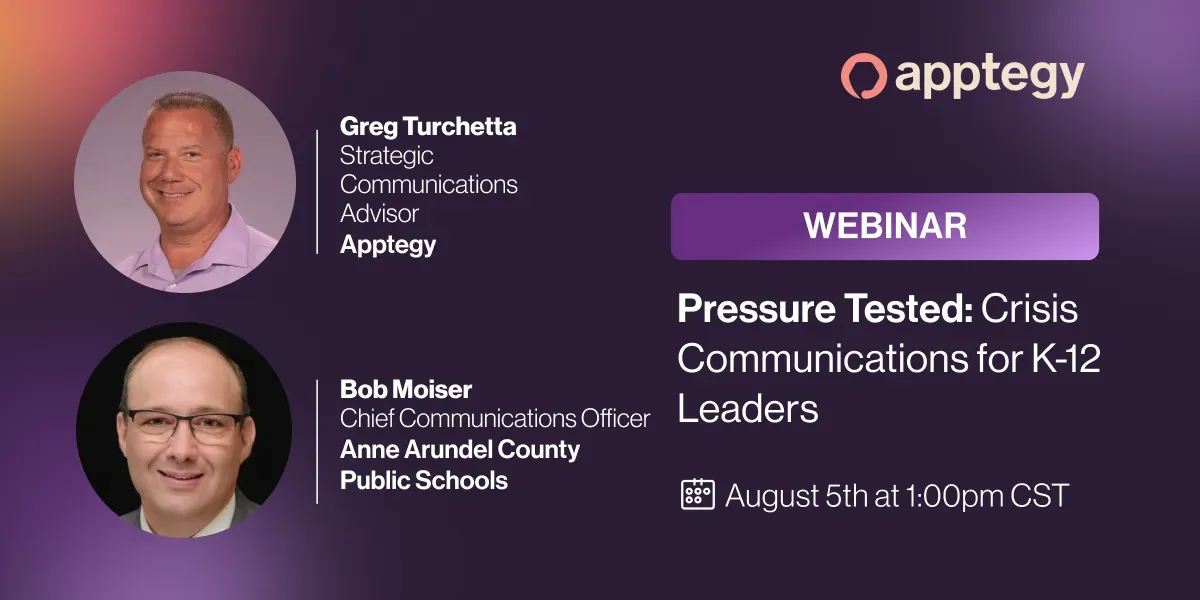
When a school crisis unfolds, the communications breakdown usually happens in the same three places: messages are delayed, facts are inconsistent, and too many people start speaking at once. This Wednesday August 5 at 1 p.m. Central time, Bob Mosier of Anne Arundel County Public Schools and frequent SchoolCEO contributor Greg Turchetta will show you how to build a practical crisis communications system—one that establishes one voice, one message and one approval chain across every channel. Register for the webinar here.
Our newest issue of SchoolCEO is out now, and it’s all about customer service and hospitality. We'll show you how to answer your families’ questions any time of day (without burning out your staff); serve your entire community by complying with new ADA standards; retain your employees with internal hospitality; and much, much more. Read the full issue here.

Three ideas to get you thinking
“Education is now an open market, so even though we’re educators, we have to adopt a business mindset. … “We can spend all the money in the world on marketing, but if a parent calls us and that front office associate doesn’t return their call, all that other work doesn’t matter.” —Dr. Dana Altemeyer, director of communications at Metropolitan School District of Lawrence Township, in “Service That Scales”
“Families may not remember every policy or presentation, but they remember how they were treated. They remember whether someone took the time to listen, whether they felt welcome and whether staff members genuinely cared. Sometimes we get so wrapped up in the day-to-day and the mandates and the scores that we can miss the little moments that make all the difference in the world to a family.” —Sheena J. Cooper, chief communications officer of Durham Public Schools, in “Be Our Guest”
Your district’s brand is not a logo. It’s how people talk about you when you’re not in the room. And in a crowded and competitive education landscape, those experiences in the front office are often what set one district apart from another. When district leaders intentionally design frontline interactions with hospitality in mind, the brand takes on a different shape.” —Brooke Allen, APR, director of communications at Crown Point Community School Corporation, in “Hospitality Starts at the Top”
/)
/)
/)