"If you leave Tinker Air Force Base from any exit, you land in Mid-Del Public Schools." For Dr. Rick Cobb, superintendent of Mid-Del Public Schools, that geography tells an important story. The Oklahoma district grew rapidly alongside the base and now serves a highly mobile, diverse community with a wide range of family needs. Military-connected families move in and out frequently. Enrollment pressure is increasing. School choice is reshaping the competitive landscape. And families do not all receive information in the same way.
In Mid-Del, communication is not a side function. It is vital infrastructure.
The challenge: Too many tools, too many pathways
That belief became even more important in 2024, when Oklahoma passed House Bill 3958, a student communication law requiring school personnel to include a student's parent or guardian in electronic communication unless the conversation occurs on a school-approved platform related to school or academic communication. The law passed in May and took effect July 1, giving Mid-Del less than 60 days to respond.
"We were thrust into it whether you wanted it or not, zero to 60 without any real time to plan," said Stacey Boyer, Mid-Del's executive director of community relations.
Rather than treat the law as a narrow compliance exercise, district leaders used the deadline to address a broader challenge: fragmented communication.
For Cobb and Boyer, the question was not whether Mid-Del would adapt. It was how to respond quickly while making communication clearer and more manageable for staff and families.
"We wanted one specific program that people use," Cobb said. "Everybody had their pet app that they wanted to use, but this new law really has some teeth and it's important that we do it correctly."
The district's concern was not a lack of available technology. It was the number of disconnected tools already in use. Coaches, activity sponsors, teachers, and other staff had developed their own communication habits, creating an inconsistent experience for families and making it more difficult to establish a clear, district-approved communication path.
The foundation: An existing Apptegy communication ecosystem
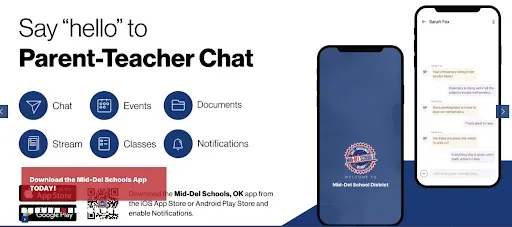
Mid-Del was not starting from scratch. The district has worked with Apptegy since 2016, using the platform for its website, mobile app, alerts, and newsletters.
That existing footprint gave Mid-Del a communication foundation it could build on when the law accelerated the timeline. "Rooms [two-way messaging] was the next piece and a big part of that solution," Cobb said.
The decision still required a culture change. Boyer said much of the pushback was not about whether communication needed to improve. It was about staff members wanting to continue using the tools they already knew.
Mid-Del kept the focus on the family experience. Scattered communication can make it harder for families to know where to look, harder for staff to understand expectations, and harder for district leaders to maintain consistency.
Boyer described the value of having Apptegy's communication tools together: "I love that you can hop in and in one fell swoop hit all your socials, your messaging, it just makes life so much easier."
The goal was not to publish every message everywhere without a plan. It was to give Mid-Del a coordinated system for reaching families across the channels that fit each message.
The moment it clicked
One of the clearest early examples came during principal training.
A high school principal had 20 students return late from lunch. Instead of calling families individually, the training team suggested sending text messages immediately. Parents began calling their students, and staff could see the impact almost at once.
The moment was small, but it demonstrated an important principle: communication tools have to reduce friction for the people using them.
Schools cannot continue adding communication responsibilities to principals, teachers, coaches, and activity leaders that requires a separate process. The value of a unified system is not simply that it adds another way to send information. It is that it gives staff a clearer, consolidated, and faster path for communicating with families.
Making accessibility part of the workflow
As Mid-Del expanded its communication strategy, the district also looked for ways to make content creation more manageable and consistent across a large number of contributors.
Mid-Del adopted Content Pro, including Level Access and AI Alt Text, to help create stronger content workflows across its websites and digital communications. In a district where site representatives, teachers, boosters, and other contributors may all publish content, maintaining consistency can be difficult.
"I don't have time to sit and write a description and hope that it's a good enough description for the image," Boyer said. "And so, that element, for me, has saved me an immense amount of time." She estimated AI Alt Text has saved her roughly two weeks of cumulative work since she started using it, and said she now uses it daily.
Boyer pointed to a bigger challenge behind that time savings: monitoring content across a large district and helping contributors understand the importance of accessible publishing practices. A single communications team cannot manually review every image, document, and page created by every contributor. Brand Pro's AI Alt Text feature has helped simplify one part of that workflow. Staff can generate a suggested image description, review it, edit it when needed, and save it before publishing.
For Mid-Del, the value is both practical and organizational. AI Alt Text reduces the manual work involved in preparing image content. Level Access adds accessibility controls and support for the website experience. Together, the tools help the district build more repeatable publishing practices as more people contribute content.
Boyer was clear that the tools are a starting point, not a finish line. The technology does not replace human review or guarantee ADA or WCAG compliance. Instead, Mid-Del's experience shows how accessibility tools can provide useful guardrails and make accessible content practices easier to incorporate into daily communications.
Communication as trust-building
Mid-Del uses recurring themes such as #MDpurpose, #chooseMidDel, and #onedistrictonefamily to reinforce its identity. Its website highlights student and staff success. The communications team produces video content and hosts a monthly podcast featuring Cobb and Boyer.

The podcast gives the district more time and narrative control than a traditional media interview. Instead of relying on a short quote or clipped segment, Mid-Del can explain its decisions, highlight its people, and speak directly to families.

That matters in a competitive environment. Families are not only evaluating academic programs. They are also evaluating leadership, clarity, responsiveness, and whether a district feels trustworthy.
"We try to over-communicate as much as possible," Boyer said. "I don't think there's any avenue that we don't try to use to reach our families."
Turning student voice into a communication channel
Mid-Del's student advisory board is expanding from a feedback loop into a storytelling resource.
The board includes 33 students, 11 from each of the district's three high schools. District leaders are actively developing a student-led social media initiative called "Mid-Del Minute," The goal is to give students a direct role in telling the district's story. Staff will support students as they conduct interviews and create content using staff-owned devices.
That approach reflects a broader understanding of communication. It is not only about broadcasting announcements. It is about giving families a clearer view of the district and creating space for students to explain what their schools are really like and why they are worth choosing.
Competing for trust and enrollment
Like many districts, Mid-Del is working through enrollment pressure. School choice, private school growth, homeschooling, and Oklahoma's voucher environment have changed the competitive landscape.

Mid-Del is not trying to win families with spin. It is trying to help them see what is already true: a district with deep community roots, a clear sense of purpose, strong public advocacy, and a serious commitment to serving families well.

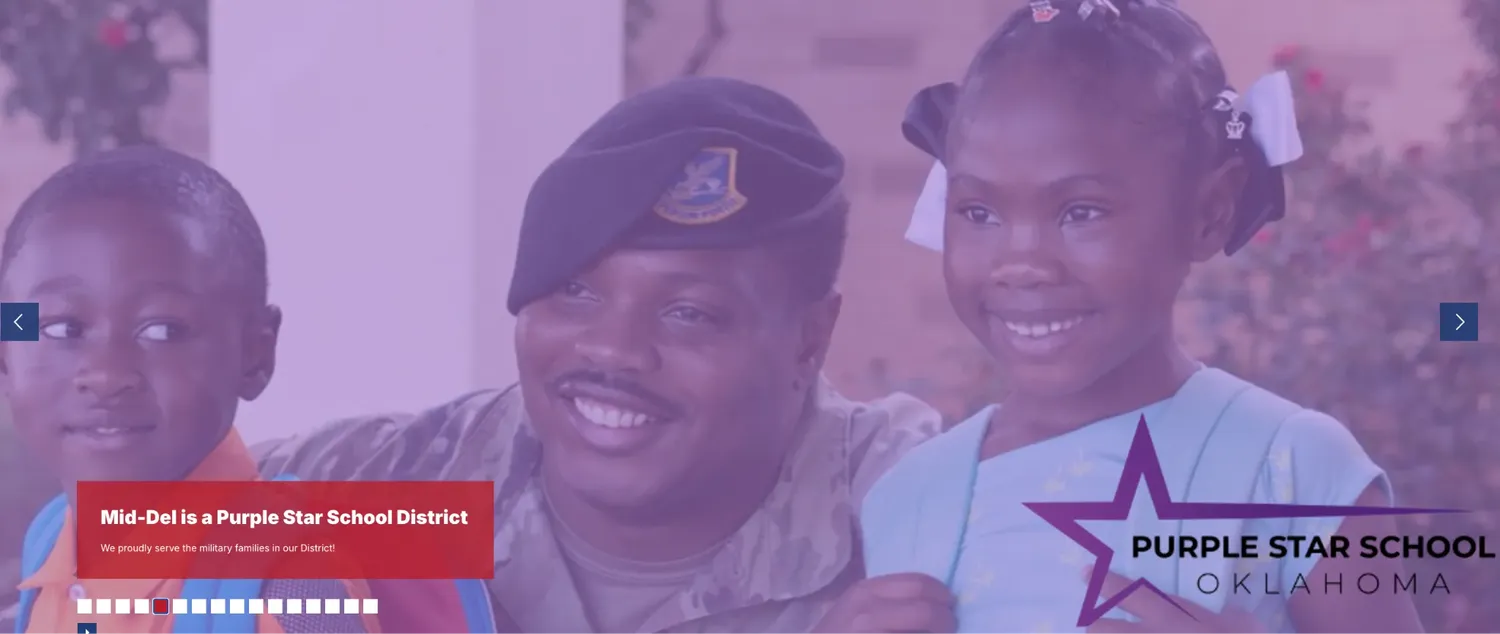
That includes military families. Mid-Del is a Purple Star designated district, and one of its schools has earned the designation individually. In a community shaped by Tinker Air Force Base, military-connected families are not peripheral to the district's identity. They are central to it.
The district's Apptegy-powered communication strategy supports that work by giving Mid-Del more consistent ways to explain its value, share its successes, reach families, and make the district easier to understand.
What other districts can learn from Mid-Del
Mid-Del's experience offers a practical model for districts facing communication pressure, changing regulations, and competition for family trust.
The clearest lesson is that urgency can clarify strategy instead of derailing it. A legal deadline became the forcing function that finally resolved a fragmentation problem Mid-Del had already been circling. Giving families one clear communication destination mattered as much as the deadline itself. Rooms succeeded not because it was new technology, but because it gave families a single, district-approved pathway for direct school-to-home communication instead of one more app to track.
None of that would have moved as fast without the groundwork already in place. Mid-Del built the two-way messaging rollout on the Apptegy foundation it already knew, its website, mobile app, alerts, and newsletters, rather than starting a separate initiative from zero. The same pattern held when accessibility became the next pressure point. AI Alt Text, and Level Access gave the district more repeatable workflows, with the understanding that human review remains essential and no tool replaces it.
Throughout, Mid-Del treated adoption honestly. A successful rollout did not require every user to change behavior overnight. It required a clear direction, practical training, and continued leadership support, extended even to letting students help tell the story. Student-generated content, through the advisory board's expanding role, is making district communications more authentic and relevant than a district-produced message alone could be.
Mid-Del did not wait for perfect conditions. When Oklahoma changed the rules around student communication, the district chose one direction and built on the Apptegy tools it already knew.
The result is a stronger communication foundation, one designed to make information easier to find, messages easier to manage, and stories easier to share.
In a moment when public schools are being asked to move faster, explain more, and earn trust with less margin for error, Mid-Del offers a clear lesson: pick a direction, simplify the experience, and make it easier for families to stay connected.
/)
/)