
For most of its history, Frisco ISD didn't market itself. It didn't need to.
"It used to be that Frisco was the place to come to," said Jacque Ballent, the district's marketing and special projects facilitator. "We had tons of people pouring in. Our enrollment was through the roof." Families moved into Frisco because they wanted Frisco schools. Demand showed up on its own. The only real challenge was managing growth, not generating it.
That era is over. And Frisco didn't wait for a crisis to admit it.
The Math Behind The Shift
Housing prices in Frisco, Ballent said, “have become prohibitively expensive," climbing past what young families can justify. That's only half the problem. Longtime residents whose kids have already graduated are staying put instead of moving out, since downsizing in Frisco now costs more than staying in the house they already own. The homes those graduated kids grew up in aren't turning over to the next young family. A student ages out, and nobody moves in behind them. "We're not turning over those students," Ballent said. "So our enrollment has been declining over the last several years."
Then came the moment that made the trend impossible to explain away.
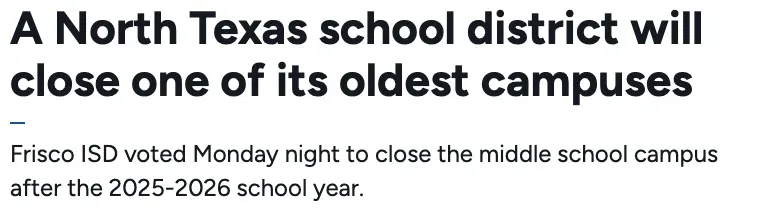
"A couple of years ago, we were building schools," Ballent said. This year, the district closed one. The closure had layered causes, an aging facility and a bond that didn't pass, but the emotional read was simpler than the mechanics. "It sent up alarm bells," she said. "I think that was the point when a lot of people realized, okay, this is a real thing."
Ballent had seen this pattern before, from the other side. She spent years running marketing for a private school in the same market. Then she joined Frisco ISD. "When I started, my position didn't exist," she said. "Initially, I was just special projects, and then I became marketing." Private schools already knew what public districts were just catching up to: enrollment isn't demographics, it's communications.
Opening the Borders
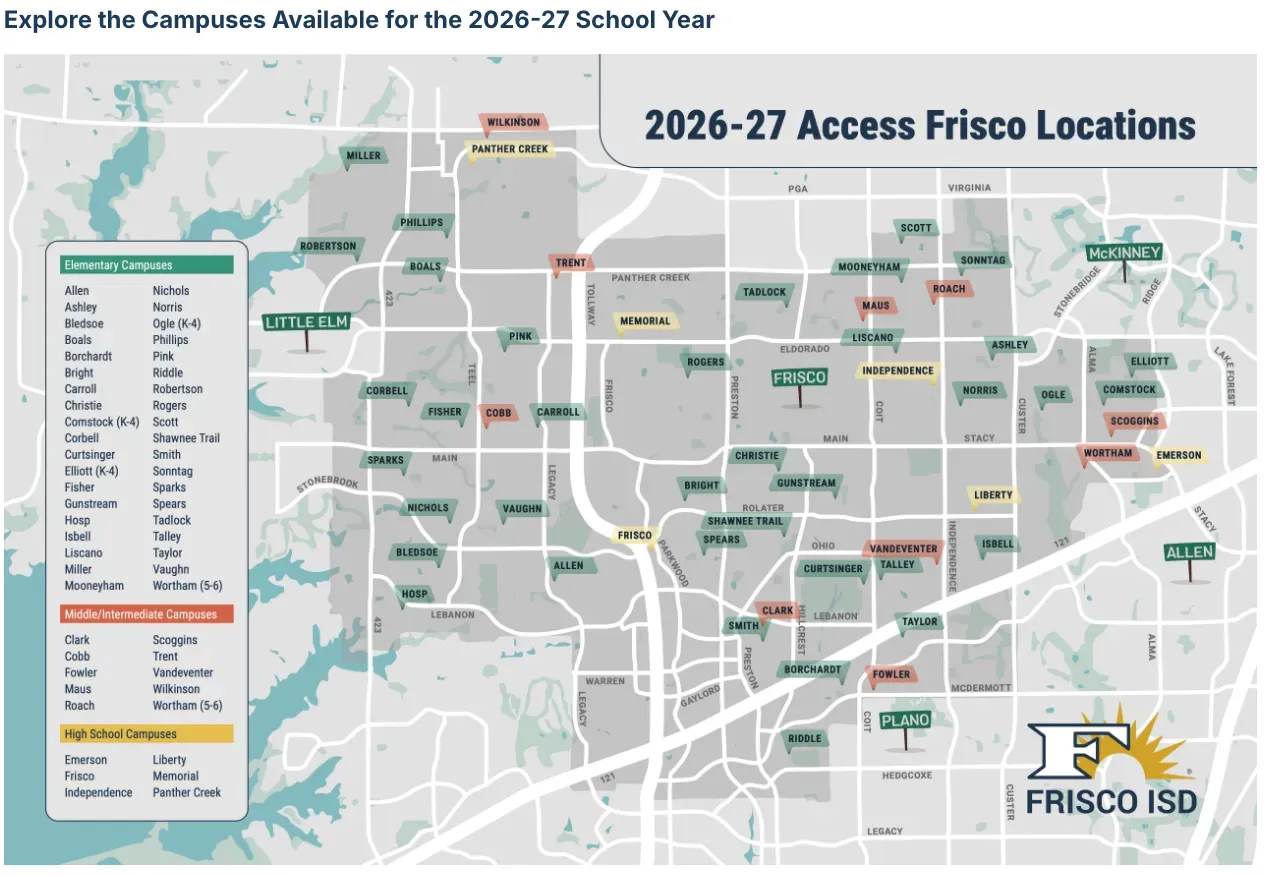
Frisco's response was Access Frisco, a program that opened district borders to out-of-district families in campuses with open seats.

A shift that significant might suggest new state legislation forced the district's hand. It didn't. "There was no legal change," Ballent said. "It was a change that was needed in the district in order to fill those open seats." When asked if this was a business decision, she didn't hedge. "One thousand percent. We're recognizing that public school districts have to think more like businesses when it comes to recruitment, retention, and the experience we are providing families.”
Ballent puts the annual funding value of a single Access Frisco student at roughly $8,000, tied to state funding generated through weighted average daily attendance. That's a floor, not a full accounting. Local and federal funding add to it, so the real value of each student runs higher than the number used below.
What the First Year Actually Returned
Access Frisco brought in 276 students in year one, against a total campaign cost of roughly $250,000 for an outside marketing partner and media buys. At $8,000 a student, that's $2.2 million in projected annual funding against a $250,000 spend, roughly 8.8 times what the district put in, a net gain near $1.96 million in year one alone.

The return compounded from there. Of the 276, 273 stayed enrolled into year two, a 98.9 percent retention rate worth an estimated $2.18 million in year-two funding from that cohort alone. Frisco didn't treat that retention as free money. The district kept investing in the Access Frisco brand through year two, both to hold onto those students and bring in more behind them. The $250,000 spent in year one wasn't a one-off. It was the first payment on a revenue base the district kept building.
Scaling the Program
Year one only extended through seventh grade, which left an obvious gap in parents' minds. "What happens after seventh grade for my kid?" Ballent said. So Frisco expanded the program to ninth grade and rewrote the pitch entirely: a clear path to graduation from an FISD school, not a temporary stopover.
Year two is still open. As of August 7, 2026, 971 new out-of-district students have enrolled for 2026-27, though Ballent is careful to call that number current rather than final. Frisco keeps accepting Access Frisco applications through the end of the calendar year, and won't know how many of these students actually show up until school starts. That count doesn't include the 273 returning from year one's cohort. Add it up, at $8,000 a student, and the program's second-year footprint is running close to $9.95 million in projected annual funding as of this writing, a number still climbing.

Selling Opportunity, Not Just Ratings
Every district near Frisco can claim strong ratings. Fewer can make their scale feel like an advantage instead of an abstraction.
"We went after opportunity," Ballent said, comparing Frisco to neighboring Allen ISD. "Allen is a neighboring school district, also A-rated, great school district, but they have one high school. In Frisco, we have 12 high schools. So instead of one football program, one theater program or one student council, we have opportunities across 12 different campuses. That gives more opportunities for students to participate, lead and find their place.” That framing gave the district something sharper than a ranking. It gave families a way to picture their kid's specific path, whatever that path looked like.
The district's tagline speaks straight to a key concern for parents in a district this size, that their kid becomes a number instead of a name. "We will know every student by name and need." Frisco also leans on its national merit numbers, more scholars than any other district in Texas, and a longevity pattern the team discovered in its own data. Students who stay in the district three years or longer consistently outscore their peers. The message became less about size and more about what size makes possible.
Competing For Families
Frisco's media strategy stayed disciplined: geofenced digital ads targeted by age, plus postcards mailed directly to homes in specific corridors.
The district saw a strong response from families in several neighboring communities, reinforcing what the team already suspected: families were willing to consider crossing district boundaries when presented with the right opportunity.
Districts are competing for the same finite pool of families now, with the kind of intentionality retail brands have used for decades. "We're not just in competition with neighboring school districts," Ballent said. "We're in competition with private schools, home schools, and charter schools." Even Frisco's own campuses compete with each other for the same enrolling families. "We want them in the district," Ballent said, "but you want them on your campus."
That reality shaped how Ballent trains her team. She can't manage the story of every one of Frisco's 77 campuses from a central office, so she doesn't try. She trains front office staff instead, especially the people answering phones, since they're the first point of contact a prospective family has with the district. "You know your story better than anyone else," she tells them. "It's up to you to tell your story."
The mindset shift underneath all of it is the real story. Ballent had to move district staff away from assuming enrollment and toward earning it. "They're not banging down your door anymore," she said. "So we have to market to families, and we have to think intentionally about the experience we provide them.”
A Website Built to Recruit, Not Just Inform
Frisco's website redesign, built in partnership with Apptegy, reflects the same philosophy. The district made what Ballent called a conscious decision to make the site more marketing forward.
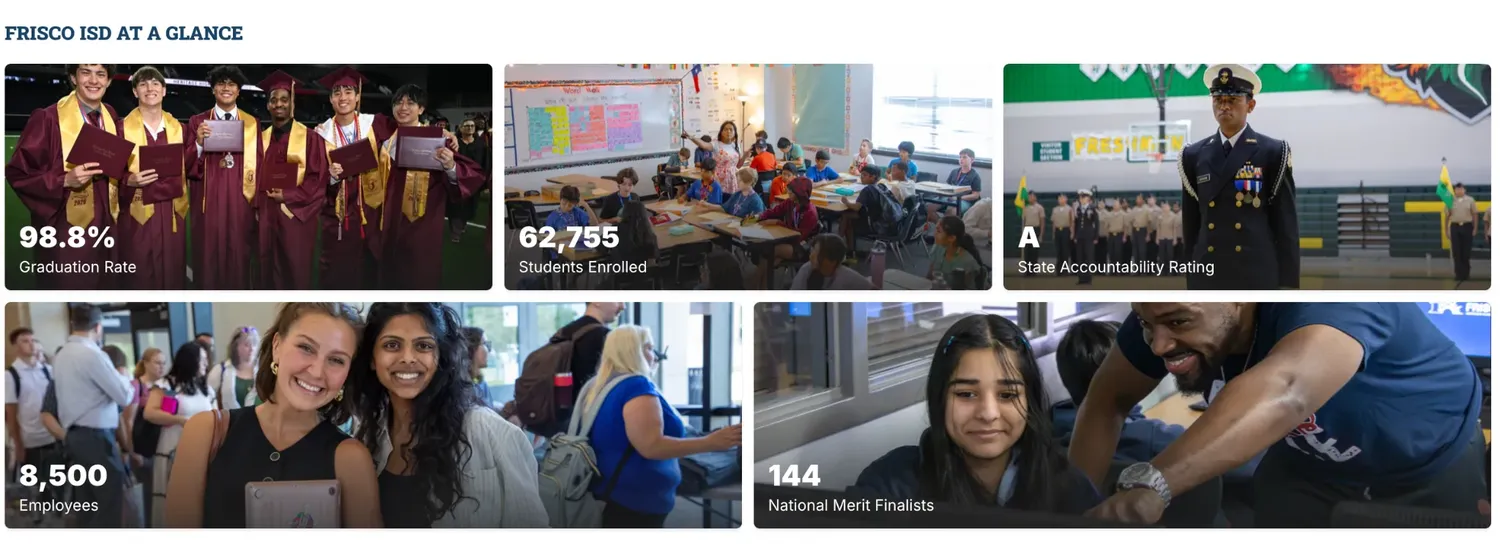

It shows. The homepage leads with proof: the largest A-rated district in Texas, more than 60,000 students, more National Merit Finalists than any district in the state. It gives prospective families a dedicated path built for people who haven't enrolled yet, instead of burying that information behind navigation built for people who already have.
Winning the click doesn't matter if the site loses the family three pages later, and Frisco's redesign was built to make sure that doesn't happen.
Two Weeks, No Budget, and a Pre-K Program
If Access Frisco was Frisco's big, planned bet, the pre-K campaign was its scrappiest win, and its cleanest return.
The decision to launch it wasn't just about filling empty classrooms. Frisco's own enrollment projections showed graduating senior classes running significantly larger than the incoming kindergarten classes behind them, a gap widened by flattening birth rates across North Texas. Every senior who graduates and isn't replaced by a kindergartner shrinks the district a little more, no matter how many out-of-district transfers Access Frisco brings in at the older grades. Pre-K was Frisco's answer at the other end of that pipeline, the earliest point where a new student can enter the district and stay for thirteen years instead of three or four.
Frisco had no tuition-based pre-K program until last year. Before opening it to the public, the district piloted it internally, offering tuition-based pre-K to district employees starting in August 2025. That pilot confirmed both operational feasibility and real parent demand before a single public dollar was spent, a low-risk way to test the concept before betting the campaign on it.
With the pilot validated, the district's superintendent looked at the remaining unused classroom space and certified staff already in place and saw a broader opportunity. He gave Ballent two weeks to build a public campaign. No budget attached.

"This was all internal," Ballent said. "In two weeks, we came up with a campaign and we launched it." The tagline: "Big dreams start with strong foundations." A 30-second video spot. A modest push on Meta and Google.
The pitch worked because the math worked for families too. Private full-day pre-K in the Frisco market runs $900 to $1,400 a month. Frisco's tuition came in at $678, positioning the district as the more affordable option without sacrificing the credibility of a full-day, curriculum-based program.
According to Frisco's own NSPRA award submission, the campaign spent $650 total and generated 146 new students and more than $750,000 in projected annual tuition revenue. The district calculated its own return at more than 1,100 to 1. The digital push behind it ran lean: 231,000 impressions, 2,950 clicks, and a cost per click under $0.11, with the 30-second video outperforming static ads at click-through rates above 4 percent. "And that's without hiring additional staff," Ballent said. "We're generating additional revenue using capacity and resources we already have."
The campaign didn't stop at paid media. An internal district article on the launch pulled more than 4,700 views and over 16,000 engagement events, and Frisco used an existing ad placement in Community Impact, reaching more than 80,000 households, to extend visibility for free. The campaign went on to win an NSPRA Golden Achievement Award.

The academic case matters as much as the revenue. "This isn't simply child care. It's a curriculum-based educational program." Ballent said. And because the district's own data shows students who stay three-plus years outperform peers, pre-K isn't just an enrollment tactic, it's the earliest entry point into a pipeline that already works. Nearly 170 out-of-district families have submitted interest forms for a possible expansion in 2026-27.
Listening Before Broadcasting
Not every insight came from a media plan. Some came from sitting down with parents directly.
Frisco ran focus groups to pressure-test its messaging before finalizing campaigns, and one finding stood out. Parents were uneasy about classroom technology. "We want the books back," Ballent said parents told her team. It's a broader trend showing up in districts nationally, but it shaped Frisco's messaging specifically, addressing a misconception before it hardened into a reason to look elsewhere.
Ballent's advice to other districts is direct: find your strengths, point them out every way you can, and listen for what families are actually worried about before they have to ask.
The Lesson
"Districts are starting to realize they have to compete for enrollment," Ballent said. "If they don't, declining enrollment eventually forces much more difficult decisions." Ballent said, "or they're going to have to start shuttering schools."
Frisco played the game early enough to still have the advantage. The districts that come out ahead next won't be the ones with the best ratings. They'll be the ones willing to run the math Frisco ran, and say out loud, before it's urgent, that families need to be recruited now, not assumed forever.
"People are starting to learn that they can't just sit back on autopilot and assume students will continue to show up."
If your district is still operating like the students will keep showing up, the numbers say otherwise. Talk to Apptegy about what a recruitment-ready website and enrollment strategy looks like, before your first campus closes instead of after.

/)
/)