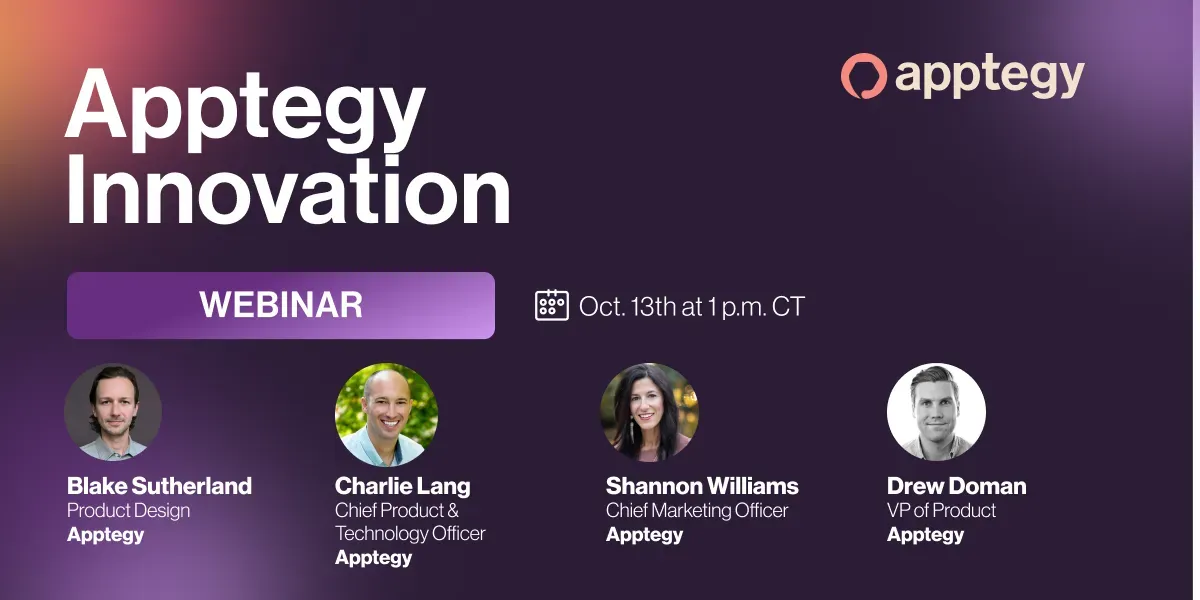
Back in June, Apptegy's leadership team shared what "All In" looks like in 2026 — reach, brand, and safety built into one platform. Since then, a lot has shipped, including the recent launch of Content Pro. In this session — following up on both June's Going All In webinar and this year's SchoolCEO Conference in Dallas — Charlie Lang, Shannon Williams, Drew Doman, and Blake Sutherland pick up where those conversations left off: what's now live, how districts are already using it, and where the platform is headed as we move into a season built around one idea — families choose, and stay with, districts that feel safe, welcoming, responsive, and trusted.
Transcript
Shannon Williams: Welcome to Apptegy's Fall 2026 Innovation Showcase. I'm thrilled to have so many district leaders, superintendents, and school communicators joining us from all over the country. Thanks for sharing where you're from. Over the next hour, we're going to walk you through what we've been building and give you a first-hand preview of what's coming next to support your schools and your communities.
Shannon Williams: Before we dive in, let me introduce you to the team that's joining me today. I'm Shannon Williams, Chief Marketing Officer here at Apptegy, and I have the privilege of being joined by our brilliant product team, Charlie Lang, our Chief Technology and Product Officer.
Shannon Williams: Blake Sutherland our Vice President of Product Design and Drew Doman Vice President of Product.
Shannon Williams: A couple of housekeeping items today, just to keep in mind.
Shannon Williams: All registrants are going to be getting a recording of today's Showcase within 48 hours by email, so keep an eye out for that. We encourage all of you to use our Q&A feature in our Zoom toolbar, and we're going to get to as many of those questions as we can. If we don't get to that, we will follow up with you directly, but we have our product experts who are also monitoring today.
Shannon Williams: And we'll be answering your questions.
Shannon Williams: So, we wake up every day at Apptegy with the intention and a mission to partner with you to simplify communication, elevate your brand, and empower every role in your organization.
Shannon Williams: We know that when schools have the right partner, the right tools, and the right strategic support, they can focus on what matters most, which is educating, engaging, and growing your community. We appreciate you all making the time to be here to make that real for you and your district.
Shannon Williams: I'm excited to hand it over to our very talented Chief Product and Tech Officer, Charlie, who has been hard at work to bring this innovation to you so that you can easily do these things that we'll cover today. Charlie?
Charlie Lang: Thank you, Shannon, and hi, everyone. It's great to be here today. As Shannon mentioned, my name is Charlie Lang. I am the Chief Product and Technology Officer at Apptegy.
Charlie Lang: I'm thrilled to be here today to share an update on what our product design and engineering teams have been building so far, at least, in 2026.
Charlie Lang: So for the past few years, we've done this presentation at our SchoolCEO Conference, and I usually begin the presentation reviewing a bit of background about myself, but we're a little tight on time today, so I'll be quick.
Charlie Lang: Like many folks at Apptegy, I'm a dad of three. All three are K-12-aged kids, and so what we build here every single day is personal for me.
Charlie Lang: It impacts me directly every day, and after spending the last two and a half years at Apptegy advancing our platform.
Charlie Lang: The importance of effective school communication has only strengthened for me. And as Shannon mentioned, our mission is really what gets us out of bed every morning to make this product better.
Charlie Lang: Umm.
Charlie Lang: Shannon mentioned our mission as a company, and that mission guides how we think about building products.
Charlie Lang: Our mission is to empower school staff to engage with their communities, and again, I'm even more passionate today than I was when I started here two and a half years ago. And it ultimately is rooted in a belief that schools deserve, rather, the very best that technology can offer. And so, as you hear our updates today.
Charlie Lang: Just know that our core belief is building excellent products that help each and every one of you achieve your missions within your community.
Charlie Lang: So, if we go to the next slide, before we get into a series of product updates, I want to zoom out and spend a few moments talking about what's happening in K-12 right now. And the truth is, the pressures we've been talking about over the last few years haven't really gone away, they've intensified. And there are 3 trends that really stand out.
Charlie Lang: If we go to the next slide, first, budgets continue to tighten, and I don't have to tell you guys this, you know this firsthand.
Charlie Lang: Federal and state funding remains uncertain. ESSER funding is well behind us.
Charlie Lang: And districts everywhere are being asked to stretch every dollar.
Charlie Lang: And that is now making efficiency a mandate in these districts, not a nice-to-have.
Charlie Lang: Schools have to move faster, they have to operate leaner, and they have to use technology to do, frankly, more with less.
Charlie Lang: The districts that thrive in the environment today are going to be the ones that use the tools and the technology to multiply the impact of their people.
Charlie Lang: Second, competition is real. School choice is reshaping the landscape faster than ever.
Charlie Lang: If we go to the next slide, our own school CEO research this summer found that fewer than half of families now enroll their zone public school or are now enrolled in their zone public school, 54% have chosen something else. And that means that districts aren't just educators anymore, they're competitors for enrollment.
Charlie Lang: So to compete, schools must market themselves, they must tell their story, and they must engage within their community in new and different ways.
Charlie Lang: If we go to the next slide, the third major force that school districts are grappling with today is the technology landscape
Charlie Lang: has never been more complicated. Districts are juggling more technology providers than ever. And if you layer on the explosion that is AI, every vendor is suddenly an AI company, and the very real security and safety obligations that come with student data have only intensified.
Charlie Lang: So think about what this looks like from a parent's perspective.
Charlie Lang: You might have an app for grades, a different app for lunch balances, one for the football schedule, a different one for band practice.
Charlie Lang: a separate login for classroom updates, and each of these apps and these logins has its own brand, its own password, and its own notification setting. It's increasingly become very overwhelming for parents to keep track of.
Charlie Lang: And on top of all that, if we go back one slide, technology introduces a lot of risk.
Charlie Lang: Whether it's protecting student data, ensuring conversations are monitored and safe, schools have more to worry about today than ever before.
Charlie Lang: So, how can schools respond? If we move on to the next slide, we believe that presenting a strong
Charlie Lang: Brand and consistent consolidated experience has never been more important.
Charlie Lang: When budgets are tight, you can't afford 6 overlapping tools, sometimes just for one student at one school.
Charlie Lang: When families are choosing, your brand is your first impression, and often your lasting one. And when the landscape is noisy, the district that offers one clear, trusted, secure front door wins.
Charlie Lang: That brings us to our product vision on the next page. At Apptegy, we believe there's a better way to engage with the community using technology.
Charlie Lang: Across channels, communication methods, and use cases. We believe in a simple motto: your brand, not ours. The entire connected experience should be about you, your website, your app, your messaging center, and your content.
Charlie Lang: And as we build new features, we stay focused on 3 key things. Number one.
Charlie Lang: We wake up every day trying to further a branded central hub for your school district, a connected front door where every touchpoint feels like one seamless, branded experience instead of dozens of disconnected logins across schools.
Charlie Lang: Number two, we want to be involved in more of your communication workflows. We want districts to increasingly use Apptegy, not just as a place to communicate, but to get work done.
Charlie Lang: Whether it's managing an attendance issue, scheduling events, sharing grades, or fundraising for your community, we want Apptegy's platform to be a place where work is done.
Charlie Lang: And then finally, It must be easy, intuitive, and seamless.
Charlie Lang: When we build a new product or a new feature, everything we build is rooted in a very strong belief that it should be easy to use Apptegy to be a better communicator.
Charlie Lang: Technology should make everyone's life easier, and unfortunately, it often makes it harder.
Charlie Lang: So, with that in mind, I'm going to head it over to our head of product management, Doman, who's going to cover some of the exciting things that we've launched so far in 2026.
Drew Doman: Thanks, Charlie.
Drew Doman: We believe so strongly in our product vision and the mission that Shannon shared that in 2026, we're making the largest technology R&D investment in our company's history.
Drew Doman: And I'm so excited to show you what we build with that investment, and how it brings more solutions to your district, your community, and to your families.
Drew Doman: If you jump to the next slide, I'm Drew Doman, VP of Product, and my team helps build the Apptegy products that districts use every day. I want to start by taking a look back at 2026. Everything we built this year tackles a problem that we heard from you, our users.
Drew Doman: Families who need answers when you're closed, absences that take all day to code, and communicating with staff who are on the front lines.
Drew Doman: Let's start with community experience.
Drew Doman: Your website is your district's front door. In March, we launched Community Experience, an AI-powered inbound engagement hub that's built using your district's live content. Let me walk you through what's actually inside it.
Drew Doman: First, we relaunched website search, and we rebuilt it from the ground up. Second, families now get AI answers in their own language, pulled straight from your website's live data.
Drew Doman: Third, we relaunched chat, so every conversation is translated and protected by AI moderation.
Drew Doman: The fourth piece is task management. This is for the questions that really need a person.
Drew Doman: Every contact us request comes in as a task to the district in one shared dashboard.
Drew Doman: Your staff can set the urgency, sign it to other people within the district, and track it all the way to completion. So requests don't get lost in someone's personal inbox anymore, and families aren't left wondering whether anyone saw their question.
Drew Doman: And fifth, there is a brand new analytics dashboard that ties it all together. So how are families actually using all of this?
Drew Doman: If you jump to the next slide, here's what Back to School 2026 looked like. In just 6 weeks, Apptegy's AI chat answered over 110,000 questions across 82 districts.
Drew Doman: There's no front office staff that could handle the amount of inbound volume by phone and email that we're seeing with community experience. Even greater is AI search that we'll see on the next slide.
Drew Doman: If you jump to the next slide, we've seen over almost 3 million answers this year. Answers any time that guardians and community members need them, in their own language, without anyone in your front office needing up to pick up a phone.
Drew Doman: Community experience gives your families great customer service without a huge burden on your central office staff.
Drew Doman: All these questions from the community got us wondering, when are families actually reaching out to the district?
Drew Doman: So we did the analysis to see when those questions are coming in.
Drew Doman: 54% of families' questions are coming in outside of the 8-4 school day window. So these are questions that are happening in evenings, and overnight, and on weekends. There is no staffing model that is built to cover those hours.
Drew Doman: But with community experience, your district can be open for questions even when school is closed.
Drew Doman: And every one of these questions is telling you an important story.
Drew Doman: If you jump to the next slide, you'll see our brand new analytics dashboard for community experience, which shows you how families are engaging, how many questions AI is handling on its own, and how satisfied your community is with those answers.
Drew Doman: My favorite part is it shows you what families keep asking on your website that doesn't yet have answers.
Drew Doman: Those are the questions that are the basis for your website's next page. So, using community experience, your community questions become the content roadmap to keep families informed.
Drew Doman: So that's community experience. Answers around the clock, incredible customer service for your community, and a clear view of what your families need answers on.
Drew Doman: Now, let's go from families' questions to students who are not yet in school.
Drew Doman: Chronic absenteeism is still one of the biggest challenges in K through 12, and you can't teach a student who isn't at their desk.
Drew Doman: What's changed is budgets are now on the line. There have been 70 bills introduced this session, 24 states are taking legislative action, and 6 states already tie funding to average daily attendance. So here's what we built to help districts out.
Drew Doman: In February, we launched Attendance Pro. It runs two-way text conversations with families about absences.
Drew Doman: You can see it here on the screen. The school reaches out, the parent replies in their native language, in this case Spanish, and the absence gets coded and documented automatically by our AI attendance agent. Let me show you what's happening behind the conversation.
Drew Doman: When a student is marked absent, Attendance Pro texts the family automatically. It captures the reason, codes it correctly, and documents all of this for compliance.
Drew Doman: Your team, your attendance staff only get pulled in when they're truly needed. When a person is really needed, like a pattern, a concerning reply, or a student who's starting to slip into chronic absenteeism.
Drew Doman: So every absence gets handled the same way every single morning. And this gives your attendance staff tons of time back.
Drew Doman: If you jump to the next slide, many districts are already live on Attendance Pro, and AI has handled tens of thousands of attendance conversations since February.
Drew Doman: One attendance team told us they're getting so much time back, they're seeing 1 to 3 hours per school per day of time savings. This is time that was previously used for data entry, but now it's going towards helping students who need intervention and support.
Drew Doman: Let me show you what that looks like for one district that we work with.
Drew Doman: Here is an example from Yukon Public Schools in Oklahoma. Clay McDonald, their district attendance officer, told us that it got so hard that people just stopped reporting absences, and that included their school staff.
Drew Doman: One month after turning on Attendance Pro, their attendance chief estimates it's cut phone work for their attendance secretaries in half.
Drew Doman: For their district, that adds up to almost 6,500 staff hours per year, and a value of $155,000.
Drew Doman: Or as Clay puts it, when you make a small, subtle change, it makes a massive difference.
Drew Doman: So that's Attendance Pro. Every absence handled, and your team's time back. If attendance is on your board's agenda this year, we would love to talk to you.
Drew Doman: So far, we've talked about families, but now I want to turn inward to your district staff.
Drew Doman: Our mission has always been to help schools become great communicators. And that doesn't stop at families. It includes how you communicate with your own staff.
Drew Doman: For years, many of you have asked us for an internal communication tool, or what a lot of districts call an intranet. And you didn't just ask once. If you jump to the next slide, this is actually one of the most requested products in our history.
Drew Doman: Our customer advisory board ranked it number one, and we had hundreds of client requests before we wrote a single line of code. So let me show you what we built.
Drew Doman: This spring, we launched what we call Staff Connect. It's a space in the Apptegy platform just for your staff, with staff-only documents, staff-only pages, and a staff-only newsfeed, all including a secure staff-to-staff messaging that's protected by our same AI chat moderation.
Drew Doman: It was designed for K-12 from the ground up, not adapted from just another corporate tool.
Drew Doman: The early results we've seen with Staff Connect are really exciting.
Drew Doman: In one early adopting district, they saw communication with parents increase by 300% once staff members started using Staff Connect to communicate internally. The takeaway is clear.
Drew Doman: When internal communication gets easier, people communicate more, including communicating with guardians. It's just that simple.
Drew Doman: So that's 3 new products in 6 months. Community Experience for your families, Attendance Pro for your attendance team, and Staff Connect for all district staff. But new products weren't the only place we invested this year.
Drew Doman: We also strengthen the platform you use every single day. We rebuilt data onboarding so the right guardian gets the right message about the right student. And contact information is always up to date.
Drew Doman: Coming soon, we're adding Rooms Analytics, so you can see activation and engagement in real time, all the way down to the teacher level.
Drew Doman: And soon, we'll launch a new smart notification center and overhauled forms, so you can edit a form after sending and see that it's translated in every family's language.
Drew Doman: I started by talking about our record 2026 R&D investment into our products, with a goal to solve more problems for your district.
Drew Doman: This is how we use that investment. So that more answers for your families when school is closed.
Drew Doman: Absences that are handled before the first period without any secretaries needing to do additional work, and one place for your staff to connect and engage internally.
Drew Doman: Now I'll hand it to Blake Sutherland to show you what we plan to build next, and how AI is making the products you already use even smarter.
Blake Sutherland: Thank you very much, Drew, and hi, everybody. My name's Blake Sutherland, and I lead our product design team here at Apptegy. One of our key goals as a product and design team, and really one of the reasons that we… the primary reasons that we build products in the first place is to help schools operate more efficiently.
Blake Sutherland: And that's why we've launched
Blake Sutherland: Two AI-first products this year that Drew just discussed, Attendance Pro and Community Experience. But almost every day, we are finding more and more use cases where AI helps schools be more successful with our existing products.
Blake Sutherland: Although there are exciting opportunities for new AI tools, which I will touch on shortly, generally speaking, we want to build smarter ones. That's why we continue to invest heavily into building AI into our existing products and tools.
Blake Sutherland: Last year, we introduced AI-powered moderation to make Apptegy the safest messaging platform in K-12. And today, there are hundreds of districts leveraging this functionality. Once a district enables moderation.
Blake Sutherland: AI screens two-way and group messages or images as they're sent.
Blake Sutherland: With AI moderation, if the model detects inappropriate images or photos, 73% of the time, it's blocked outright, removed the moment the sender hits send, so no student, parent, or staff member ever sees it.
Blake Sutherland: That's safety at a scale no human team could deliver, and it's become one of the biggest reasons districts choose Apptegy.
Blake Sutherland: Another area driving value for our clients is AI alt text generation. When staff upload an image, AI writes an accessible description automatically.
Blake Sutherland: And since last September, it's written over 1.3 million alt text descriptions for images posted to announcements across nearly 1,400 districts.
Blake Sutherland: When AI writes the alt text, it averages about 115 characters, which is an actual description of the photo.
Blake Sutherland: When staff have to write it themselves, the average is only 9 characters. And 42% of the time, it's just a single character, a letter, or an emoji, or even a number.
Blake Sutherland: So this is the difference between an image that a screen reader can truly describe, and one that is really just technically achieving alt text.
Blake Sutherland: Ultimately, that's the type of work where AI should be leveraged. We want to empower the shift in school districts from reading message logs to building relationships, from checking spreadsheets to helping the families who need it most.
Blake Sutherland: AI handles the repetitive work, so your teams can do the real work.
Blake Sutherland: As Drew shared, it's been a busy but really exciting 2026. And looking into 2027, the pace isn't slowing down. We're excited to announce a series of major capabilities arriving over the coming year.
Blake Sutherland: And we'll start here. In 2027, we'll begin rolling out Apptegy Identity Management, providing school administrators with the ability to navigate and manage your student and staff data more easily than any other platform that you use today.
Blake Sutherland: Our goal isn't just to make your staff and student data work better with our platform, it's to make the data better overall. That includes helping you identify issues with that data and override inconsistencies when they occur.
Blake Sutherland: Over time, our hope is that Apptegy isn't just a system of record for your communication, but also how you manage and track the identities of your staff and students.
Blake Sutherland: Second, we're rolling out better permissioning for bulk updates. As districts do more and more on the platform, more people on your team need the ability to make changes at scale. New granular controls will let you delegate bulk operations to the right people.
Blake Sutherland: right level without handing anyone the keys to the whole district. More people helping without more risk.
Blake Sutherland: And in addition, next year, forms will be launching in Rooms. This functionality allows teachers, coaches, and anyone managing a room to create private forms for certain guardians and students.
Blake Sutherland: This also includes expanding the types of fields and use cases that can be added to rooms.
Blake Sutherland: Room owners will be able to create signups for events, allowing guardians and students to RSVP.
Blake Sutherland: And here's one we know many of you have been waiting for, parent-teacher conference scheduling.
Blake Sutherland: built right into rooms. Teachers can set their availability, families pick a time slot right in the app in their own language, reminders go out automatically, and that endless back and forth of the scheduling season disappears.
Blake Sutherland: That's just a few of the things we have in store for 2027. Between the investments in data, the permissioning, and the workflows, our teams remain committed to making Apptegy
Blake Sutherland: The best platform, and increasing and improving the user experience for your district.
Blake Sutherland: But finally, let's talk about the thing that we're most excited about.
Blake Sutherland: If we think back to Apptegy's initial founding, the company's mission has always been to empower school districts to be great communicators. And as a lot of folks on this call know.
Blake Sutherland: Great communication is not easy. It requires the right mix of distribution channels, the right timing, and a strategy to build an effective narrative over time. But ultimately, great communication strategies all must have one thing. Great content.
Blake Sutherland: And that's why we are thrilled to introduce the next generation of Brand Pro, a new product we call Content Pro.
Blake Sutherland: Content Pro includes everything you already love, premium templates, right with AI, AI alt text, newsletters, but with so much more.
Blake Sutherland: Let's start with accessibility, because it has become one of the most important topics in K-12 communication technology.
Blake Sutherland: Every family, of course, deserves equal access to information about their child's school. That's always been true. But beginning in 2027, new federal regulations raise the bar for what a K-12 district is legally required to do.
Blake Sutherland: And we know everyone here loves PDFs. They are everywhere in K-12, handbooks, menus, schedules, board documents, you name it. Your communications team receives a PDF, and it gets uploaded to the website.
Blake Sutherland: The problem is the vast majority of PDFs are not accessible.
Blake Sutherland: And our answer to that is AI Page Builder.
Blake Sutherland: Upload a PDF, or start from a prompt, and AI turns it into a structured, accessible, and translated webpage in your CMS. Every page still gets your review before it publishes, so you stay in control while the busy work is handled for you.
Blake Sutherland: But making content accessible isn't… is really only half the battle. For many districts, figuring out how to manage the rest of the standards can feel overwhelming. Audits, remediation, ongoing monitoring. That's why we are thrilled to announce a partnership with Level Access.
Blake Sutherland: Level Access, the tools that they provide are AI-powered remediation that helps fix accessibility issues in your content automatically.
Blake Sutherland: And critically, it includes attorney-led support. If your district ever faces an accessibility complaint, you have real experts in your corner, not just a software widget.
Blake Sutherland: So we're enabling more accessible content, but let's talk about creating great content. Think about what happens today when something significant happens in your district. School closure, leadership transition, or even just an exciting upcoming event.
Blake Sutherland: Someone on your team has to write that message.
Blake Sutherland: We set out to understand how AI can help districts write better communications. We started by looking at billions of messages sent through the Apptegy platform over the past decade.
Blake Sutherland: We created a proprietary scoring framework that identifies the best communication sent in our platform based on things like clarity and completeness. And from there, we built a product that allows every district to quickly write the perfect K-12 communication.
Blake Sutherland: Introducing Apptegy Content Creator, powered by AI.
Blake Sutherland: Unlike generic AI tools that you might be using today, Only Content Creator leverages real district communications to ensure you're not just writing clear messages, but messages that include all of the important details that your community cares about.
Blake Sutherland: From a single prompt.
Blake Sutherland: Content Creator generates a well-written and structured K-12-specific message tailored to the channels that you select.
Blake Sutherland: On generation, each channel is scored. To give you an immediate sense of what needs attention.
Blake Sutherland: And not only that, but follow-up questions let you fill in the exact details that makes your specific message more complete and more clear.
Blake Sutherland: You can add channels as you need them, going through the flow, and you can also prompt additional prompts and instructions to add those special touches or details, like emojis, or anything else that might make that message really your own.
Blake Sutherland: Content Creator's going to be in beta later this year, with a planned rollout in early 2027 for all Content Pro clients, and we really can't wait for you to get your hands on this.
Blake Sutherland: In summary, one package focused on your brand with accessibility compliance at the forefront and tools that turn hours of work into minutes. This is Content Pro, and it rolls out this fall.
Blake Sutherland: This time, I'll turn it back over to Charlie to bring us home.
Charlie Lang: Thank you, Blake. And I think, as you can see, it's been a very busy 2026 for the Apptegy product and engineering teams.
Charlie Lang: We've launched not only new products, we've launched AI first products.
Charlie Lang: And we've continued to innovate and advance the existing products.
Charlie Lang: That our districts know and love from previous years. And while 2026.
Charlie Lang: has been incredibly busy. You also saw that 2027 is going to be equally as exciting, with more innovation undoubtedly to come. So I will end today where I started. The challenges facing districts today are more present than ever before.
Charlie Lang: Budgets are tight.
Charlie Lang: Making efficiency a mandate. The rise of school choice isn't slowing down, and districts are increasingly competitors.
Charlie Lang: And putting a consistent brand and identity into the world is more important than ever. And the technology landscape has never been more complicated.
Charlie Lang: With the emergence of AI,
Charlie Lang: Data privacy and security issues are on the rise, and so to address those challenges, we believe
Charlie Lang: in one branded central hub. One central place where your district can provide its identity across channels, across communication methods, across formats, where parents and community members can engage directly.
Charlie Lang: With inbound, outbound, and internal communication increasingly with Staff Connect.
Charlie Lang: to create a perfect communication environment for your district, and the perfect communication sent through things like Content Creator.
Charlie Lang: We believe very strongly in the mission that Shannon introduced today, and at the end of the day, our product and engineering teams wake up every day trying to deliver the very best that technology can offer to the districts that we serve.
Charlie Lang: So that's all the content we have today. I will turn it over to Shannon to close us out.
Shannon Williams: Thank you, Charlie, Blake, and Drew. Very exciting stuff happening here. We know that, like Charlie said, districts that are going to lead in their communities over the next decade aren't waiting for the perfect moment. Y'all are building these systems now, and we're glad that you joined us today because you're one of those.
Shannon Williams: If you'd like to learn more, we've seen the Q&A, be very active today with interest, which is awesome. But if you'd like to learn more, simply answer this poll that's gonna pop up.
Shannon Williams: Or you can feel free to scan the QR code to book time directly with us to learn more, or you can simply send an email to marketing@apptegy.com.
Shannon Williams: So, looks like we have some time, hopefully this team is up for it, but I'm going to, start with a couple of questions, that have come in. So, the first one, let's see…
Shannon Williams: Drew, or let's see, Blake, this may be best for you. It says, I have an AI that I use to write content and have trained it for my district already. How is Content Creator different, or what benefit would I get from it that I wouldn't get from using what I use today?
Blake Sutherland: Yeah, great question. Unlike the general purpose AI tools, content creator Speaks.
Blake Sutherland: if you will, K-12, so that whether you're generating newsletters or alerts or family messages, when it writes, it'll sound like it comes from a school communicator, and that's first and foremost.
Blake Sutherland: Secondly, I would say that, content creator is optimized on completeness.
Blake Sutherland: of the messages. So as, you're prompting a message.
Blake Sutherland: It knows, really where things are missing, and it will prompt you to fill that in. That isn't something that you would get with a general purpose AI tool, or one of the tools that you might be using now. And as I demonstrated, or as the slide showed, it will prompt you to fill in those gaps. It knows where those gaps are.
Blake Sutherland: And it's asking you for the content to fill them in. And I would say, lastly, it won't invent those blank spots, so it doesn't make up any content or hallucinate anything to populate there. It will always prompt you to say, what should we include here, if it does detect that something's missing from the message.
Shannon Williams: Awesome. Very smart. As a fellow marketer, I love this capability. I'd like to have it myself.
So, the next one looks like maybe, Drew, you can jump in. It says, how long does it take to get Attendance Pro running? We are, like, mid-year.
Drew Doman: Yeah, absolutely, it's a great question.
Drew Doman: Plus or minus, it takes about a month. Obviously, it depends on district size and how many attendance staff we want to train, but we take that month to onboard your data, train our individualized custom AI attendance agent on your attendance codes and your attendance policies.
Drew Doman: And make sure your community is ready for the new tool to be rolled out. So, on average, in this back-to-school season, we've seen that's taken a month from, you know, from hitting go to launching, but obviously we'll customize that to each individual district to make sure the rollout is as successful as possible.
Shannon Williams: Great, thank you, and this next one looks like it may also be for you. Sorry, I'm gonna keep them coming, if that's alright, Drew. Please. Alright, so it says, how are districts leveraging Staff Connect when it comes to staff email?
Does it replace it, or sit alongside it?
Drew Doman: Yeah, as with any good communication strategy, multiple channels are super important, and so we don't see necessarily that we're replacing email, but we see Staff Connect as a very important complement to email.
Drew Doman: We see that you'd be able to point your staff to a central place where there's approved documentation, approved pages, approved information for things like HR and payroll, and everything your staff needs to know in terms of policy. And you can communicate that using email, sending links to the Staff Connect pages.
Drew Doman: And repository, or you can use the staff-to-staff secure chat for more real-time, quick answers, where an email isn't needed. So, we see it as a great complement, and not necessarily as a replacement.
Shannon Williams: Very helpful, thank you, Drew. Alright, and another one came in, Martin asked if Staff Connect allows, SSO login with Google, and yes, it does, Martin, so hopefully that's helpful for everyone.
Shannon Williams: Okay, there's a…
Shannon Williams: Let's see… I think that takes care of most of those that have come in. I think we have the poll that's gonna pop up for anybody that wants to…
Shannon Williams: have someone from our team reach out to learn more about any of the things that you saw today that are of interest. Again, we've seen lots of activity of interest in the Q&A and the chat, so please just answer the poll here.
Charlie Lang: Shannon, I think there's one that came in from Vijay on performance.
Charlie Lang: So one the question is what kind of investments are you making on performance of existing products? One thing that I will say, and Drew said this at the beginning of his section.
Charlie Lang: Is that, we're going to invest more in R&D in 2026 than ever before, and there's a lot of new products, there's a lot of new features, but we're also continuing to double down on our existing products.
Charlie Lang: So, our alerts are going out faster than ever before, our websites' uptime have never been higher, and we continue to double down on not just performance of our products, but also the quality of those products.
Charlie Lang: And so, if you're an existing client and wondering what's happening with the existing platform, we continue to innovate there, and we continue to invest in the stability, quality, and performance of our existing products.
Shannon Williams: Great, thank you, Charlie. Yeah, I saw that one come in just at the last second, so I appreciate you jumping in.
Shannon Williams: Great.
Shannon Williams: Well, thank you all so much for joining us today. As a reminder, the recording is going to be sent to you with the email that you registered with.
Shannon Williams: And if we… it looks like we got through all of the questions, but, if there's something that you want to drop into the Q&A quickly, we will make sure that we follow up directly. If you did have a question, and we said we would reach back out with more information, we will also be doing that. So, we really appreciate you finding some time to spend with us today, and
Shannon Williams: And we will talk to you soon. Thank you.
Shannon Williams: Bye.