
In the article ahead, Baltimore City Public Schools CEO Dr. Sonja Brookins Santelises reflects on a 30-year mission to put equity in urban education into motion—expanding access to rigorous learning, enriched experiences and whole-child supports at scale. Her North Star is simple: Treat "other people’s children” like your own.
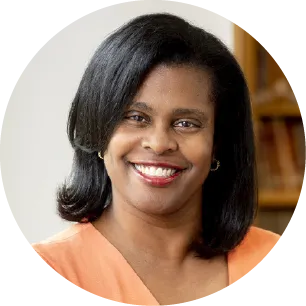
As a young teacher in Brooklyn, New York, Dr. Sonja Brookins Santelises once took her middle school students to the skating rink at Rockefeller Center. “The kids were enthralled,” she recalls. “I was like, ‘You guys, this is just a train ride away.’ But to them, Manhattan was a whole other world.” Moments like this one showed Santelises how little access and exposure some children in urban schools were getting to new experiences. Giving overlooked students that access—to broaden their sense of possibility and ultimately shape their future—has since become a hallmark of her 30-year career.
Now the CEO of Baltimore City Public Schools, Santelises is currently in her last year at the district—but she’s certainly going out with a bang. Just this year, she was named Maryland State Superintendent of the Year and was one of four finalists for AASA’s National Superintendent of the Year award. These accolades might seem bittersweet, coming at the end of her 10-year tenure at City Schools, but Santelises doesn’t think so. “It's just sweet,” she says. After all, the awards are an acknowledgment not just of her achievements, but those of her colleagues and the entire district. “It's great for me, of course, though I think most importantly, it really is an acknowledgement of the work of the entire City Schools team,” she says.
CEO is certainly an apt title for the superintendent of City Schools, a district with nearly 77,000 kids, over 11,000 employees and an annual budget of roughly $1.9 billion—as large as some multinational corporations. Since taking the role in 2016, Santelises has overseen measurable academic improvements across the district. In the 2024-25 academic year, City Schools students recorded their ninth consecutive year of gains in English Language Arts on Maryland’s state assessments—an increase of nearly 16 percentage points during her tenure. Those gains outpaced statewide progress each year. And following the disruption of COVID-19, City Schools was one of only two districts in Maryland whose reading performance exceeded pre-pandemic levels. Math scores have also risen for three consecutive years across all grades.
Still, academic gains tell only part of the story. Much of Santelises’ work has focused on deeper questions: Who gets access to the education and experiences that help a young person excel? And how can urban schools help these students excel at scale?
Where the Mission Began
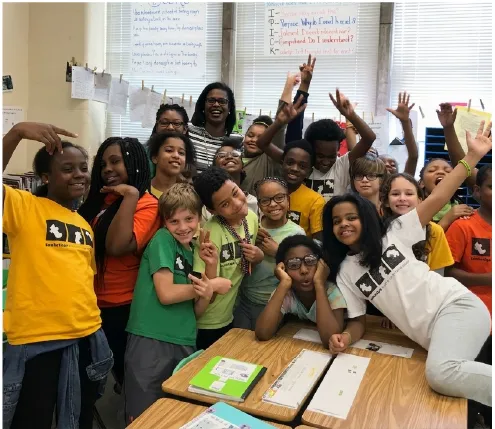
In some ways, Santelises has been preparing for this work her whole life. In her childhood home outside Boston, education was revered for the opportunities it had afforded her forebears. “I was often reminded of the generational moves we'd been able to make as a family because of education,” Santelises says. So perhaps it’s no surprise that she began playing “teacher” at a very young age. “I remember having a slate chalkboard that I loved to play on,” she recalls. “I had a teacher's edition of a textbook—a first- or second-grade reading anthology—and I remember making homework sheets, having kids pretend to fill them out, and correcting them.”
Her interest in teaching was strengthened by watching “The Marva Collins Story” on television. Based on a true story, the film followed a Chicago educator who, frustrated with the way the public system ignored some students, started her own school for children who had been written off academically. The story left a lasting impression. “I have always been drawn to young people whom others did not view as capable, whom others doubted,” Santelises says. “I love proving people wrong.”
However, when she told her parents she wanted to become a teacher, her mother had mixed feelings. “She grew up in an era in the South where the two things educated Black women did was teach or marry preachers,” Santelises says. “She didn’t want that for me. She had her heart set on me being the next Condoleezza Rice.” Santelises ultimately pursued education anyway, earning her bachelor’s degree and two postgraduate degrees from Ivy League universities.
During her studies, Santelises was particularly interested in the work of Lisa Delpit, an education researcher and author of the book Other People’s Children. In it, Delpit writes about the cultural assumptions made by teachers and institutions that lead many students of color to receive an inferior education. The book forces education professionals to ask themselves, “What do we really believe about other people’s children?” says Santelises. That would become the lens through which she viewed her own work.
First Impressions
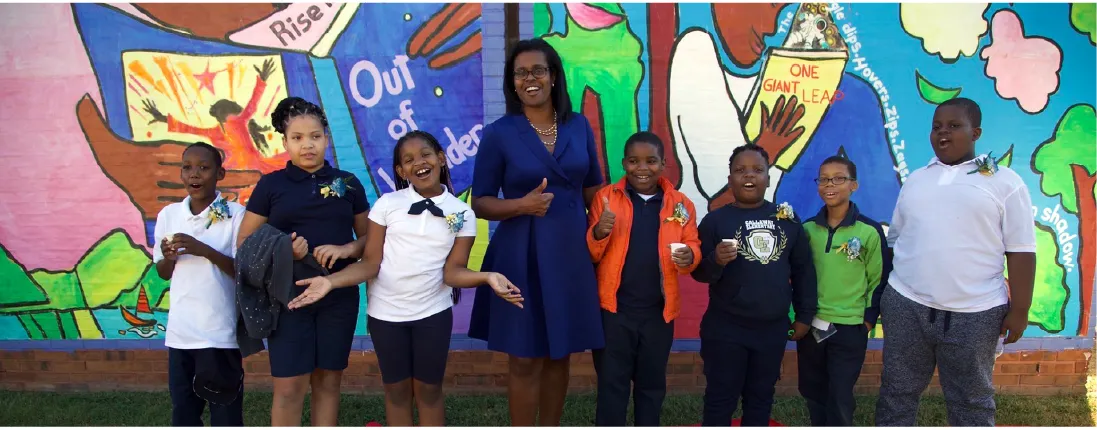
Santelises’ early career quickly exposed her to the realities of American public education systems. She first worked for the newly formed Teach For America, helping place teachers in underserved communities around the country. “I got to see what urban and rural schooling looked like from a lens of recruiting teachers,” she says. But working with teachers only made her more eager to get into the classroom herself.
Soon she began teaching at Decatur-Clearpool School, a new K-5 elementary in Bedford-Stuyvesant, Brooklyn. When it was decided that Decatur-Clearpool should have an associated middle school as well, Santelises was tapped to help create it. She’d go on to teach humanities and algebra at the middle school she co-founded, where she discovered a particular affinity for that age group.
“They're quirky. They want to be grown-up, but they're not quite grown-up. They're ready for more, but they still have those little kid tendencies,” Santelises says. It’s a pivotal stage in human development but also in the trajectory of a student. “What you get programmed for and oriented to during that early adolescence period really does dictate what you're going to do after,” she explains.
Teaching math at the middle school level naturally led Santelises to her next role heading up the New York City Algebra Project. “I was enthralled with founder Bob Moses and the connection he drew between algebra and civil rights,” says Santelises. Crucially, Moses recognized that if students don’t take algebra in middle school, they are often locked out of higher-level math—and eventually higher-level careers. “The ability to understand numbers means you understand data, finance and patterns,” she says. “That gateway experience dictates your access to rooms with power and careers in technology.” With the New York City Algebra Project, Santelises helped low-income students build the necessary math skills to access those rooms and careers.
Bringing the Mission to Baltimore
After the Algebra Project, Santelises spent two years lecturing on urban education at Harvard and six more coaching leaders at urban school districts with Focus on Results, Inc. She later moved into district leadership at Boston Public Schools before joining Baltimore City Public Schools as Chief Academic Officer in 2010. She spent the next several years grappling with the impact of the city’s history with redlining.
Beginning in the 1930s, in Baltimore and elsewhere, businesses denied services and bankers denied mortgages to African American neighborhoods while favoring white areas. While the Fair Housing Act of 1968 officially outlawed redlining nationwide, the legacy of those decisions still shapes Baltimore today, contributing to concentrated pockets of poverty that fall within the boundaries of City Schools.
“We have schools where 90% of students live in concentrated poverty,” Santelises explains. “By concentrated poverty, I mean students with food insecurity and unstable living conditions who might be moving two or three times a year. I mean students living in under-resourced sections of the city where parks and rec centers might be scarce—parts of the city where parent groups might not be available to take kids to dance or swim lessons across town. That doesn't mean those students aren't capable of achieving. But it does mean they need more support.”
As Santelises and her colleagues analyzed the district’s policies, they discovered that City Schools had been exacerbating the problem. “We realized that, frankly, we as an educational institution had also redlined,” she says. “We had redlined who had access to Algebra 1 in middle school, who had access to enriched curriculum and experiences, and who did not.” Erasing those red lines became central to her work. But to do that, the district would need to show those children extra care, while at the same time demanding more from them.
Equity in Motion
Santelises stepped away from City Schools in 2013 to become vice president of K-12 policy and practice at The Education Trust, a national organization focused on closing opportunity gaps in American education. However, watching students from City Schools’ Frederick Douglass High School clash with police on live TV inspired her to return to the district.
Those clashes were in response to the treatment of Freddie Gray, a 25-year-old Black Baltimore resident who suffered a severe spinal cord injury while in police custody and died one week later. The protests that ensued were characterized as riots and the protestors criminals and thugs. “I came in on the heels of the Freddie Gray incident,” Santelises says. “I saw how those young people were being portrayed, and it hit me: The time you have to make a change in the superintendency is not long, but it has the power for generational change.”
So in 2016, Santelises rejoined City Schools—this time as CEO—where she began work on the district’s “Blueprint” for student success, setting literacy and “student wholeness” as top priorities. She created the district’s first Office of Equity to draft an equity policy and ensure district practices actually aligned with it. But Santelises didn’t want equity to just be another box to tick. “My goal was ‘equity in motion,’” she says. “We were working to ensure that young people from all sections of the city had access to an enriched education—an education designed to train people to become leaders.”
Enriched Education
For Santelises, equity in motion comes back to treating other people’s children like your own. “If the classroom is not good enough for your children, niece or neighbor,” she says, “then it isn't good enough for other people's children.” She began by introducing new culturally relevant, standards-aligned curricula for all K-12 students that emphasized connections to their lived experiences. With her team, she created a new rubric for assessing teacher performance, while adding more professional development opportunities and providing equity training.
Santelises knew from her time at the New York City Algebra Project that missing algebra in middle school could be detrimental to students’ futures, but some of the district’s middle schools didn’t even offer Algebra 1. So her team leveraged virtual algebra classes to give every school access to the course. “We have to own the education of children along the full arc of their lives. If we are passing along children who aren't at a particular level, we still own that under-education,” she says.
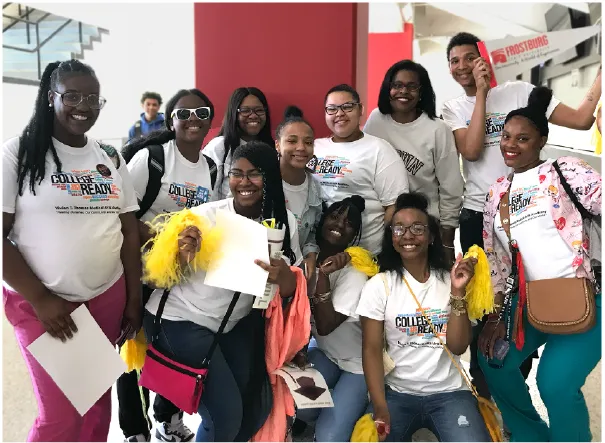
Santelises was determined to set her students up for success after graduation—whether they went to college or straight into a career. She broadened City Schools’ career and technical education programs to focus on in-demand jobs that earn a living wage, and expanded access to advanced placement courses. “We have kids in every pocket of the city going to Johns Hopkins and Harvard because they now have access to AP Calculus,” she says proudly. So has Santelises succeeded at putting equity into motion? You do the math.
Enriched Experiences
When Santelises mentions enriched opportunities for students, she is referring to more than just higher level math lessons. She’s talking about a well-rounded education with language, technology and art classes—the kind of education she’d want her own children to have. During her tenure, the district has doubled its number of visual and performing arts teachers, and seen more graduates pursue careers in the arts. Students of the district’s Baltimore School for the Arts have gone on to perform with the world-renowned Alvin Ailey American Dance Theater troupe; at one time, alums even accounted for a full fifth of the company.
The district has expanded extracurriculars and clubs, too. It's home to multiple robotics teams and more athletic offerings than ever before. “Our middle school athletics program frankly grew out of my desire as a mom,” says Santelises. “I have two daughters who played field hockey in middle school, and I was sitting there watching one of the games and thinking, This is crazy. All kids need to have this access.” But at the time, students at high-poverty schools didn’t have many opportunities to get out and move their bodies. “Middle school athletics is crime prevention,” says Santelises. “You’re giving them something better to do.”
Santelises sums up many of her reforms this way: “I don't do schooling that’s reduced, watered down, no joy, no rigor. What we have worked on together as a team is making sure that is not the case at City Schools.”
Building a Better Future
Not long after Santelises became CEO, she faced a major crisis. During a particular winter with record-breaking low temps, no less than 80 of her schools experienced major heating problems. Some schools closed, while students wore coats and scarves to class at others. Needless to say, the district came under fire, and parents were outraged. To Santelises, the incident underscored how infrastructure affects learning. “The number of learning days lost due to antiquated buildings and systems is not insignificant,” she tells us. “And we have the oldest building infrastructure in Maryland.”
Santelises got to work immediately to address the heating problem and other infrastructure issues. The district used pandemic money to refurbish bathrooms that hadn't been touched in decades. They renovated dozens of aging roofs. During her time as CEO, Santelises has also initiated a flurry of new construction. The district has constructed 30 new buildings, including two net-zero buildings that only consume as much energy as they produce. Four additional buildings are in progress.
Santelises believes these changes carry powerful symbolic meaning. “Space communicates what we think about students and their potential. When you see young people walk into a new space with open windows and an atrium, or an art room that looks like an art room should, you can see the change on their faces,” says the CEO. “High-quality space tells students, ‘We believe you're supposed to lead.’”
The Whole Child
Recognizing the links between health, wellness and student achievement, City Schools has invested in a range of services to support student wholeness. This means not just expanding athletic offerings across the district, but also introducing nutrition and physical fitness programs.
In addition, every high-poverty school in the district was assigned its own social worker and its own community school coordinator—a staff member who connects families with services like housing assistance and food support. “You need somebody else—this community school coordinator—to help deal with those other life issues that a fourth-grade teacher is not prepared for,” Santelises says.
Building stronger connections between students and adults is another measure the district is taking to support student wholeness as well. After all, school can be a safe space for children who do not feel very safe at home—but only if they have someone they trust. “Our goal is for every student to have at least one caring adult they can go to,” Santelises says.
What Comes Next
Looking back at her time leading City Schools, Santelises wants her legacy to be “that a large system can run well,” she says, “and that the young people in Baltimore are worth fighting for.”
However, Santelises is not retiring; she will continue to be a defender of excellence and an advocate for equity in urban schools as the next superintendent-in-residence at the Broad Center at Yale School of Management. In the role, she will teach and mentor future K-12 leaders. “I am working with potential new systems leaders and those aspiring to the top seat,” says Santelises. “We need a pipeline of leaders who lead with heart and skill.”
A leader with plenty of heart and skill herself, Santelises reiterates a bit of wisdom that has guided her 30 years in the field. While the problems that public schools face may be complex, the solution may be simpler than we think. “We could ameliorate a lot of the challenges of education,” she says, “if we just viewed other people's children as being worthy of what we want for our own.”

/)