Jefferson County sits at the far eastern edge of West Virginia, close enough to Washington, D.C. that some parents commute in for work. Average household income runs near $98,000, roughly double the state median, and the average home costs $400,000. Loudoun County, Virginia, one of the wealthiest counties in the country, is an eight-minute drive from the district office.
That proximity shapes expectations more than geography does. Parents here benchmark the district against neighboring Virginia systems, not against other West Virginia counties, even though West Virginia's statewide salary schedule means Jefferson County teachers earn anywhere from $13,000 - $50,000 less than colleagues teaching the same grade level a few miles away. The district can't close that pay gap. What it can control is whether families actually see the work happening on a West Virginia budget under Virginia-level scrutiny, and that job landed on communications.
That team is three people — two full-time communications professionals and an administrative staffer who also manages the front desk at the central office — covering 16 schools and roughly 8,000 students. 'We put out almost two pieces of content a day,' Kelcie Springer said. 'We're making more than 500 unique pieces of content a year on a good year.”
Replacing a Guess With a Question
Kelcie Springer became Jefferson County's communications director two and a half years ago, after two years at Berkeley County Schools. Before she worked in education at all, she came up through traditional marketing roles, including restaurants, where the job had one clear number attached to it. “When I worked in restaurants, year over year revenue was my job,” Springer said. “If we were up ten year over year in revenue, I could measure that.” Communications departments rarely have an equivalent number to point to.
“When you come into communications, we're always kind of this amorphous thing,” Springer said. “How do you measure success? I don't think we need to overcomplicate it. I overcomplicate things. I'll just ask. It's not rocket science. It's a Microsoft form.”
She built a roughly 20-to-25-question survey and asked stakeholders directly how they would rate communication at the teacher, school, and district level. No consultant, no complex instrument. The same question, asked the same way, every year. “This isn't to celebrate a quick win,” Springer said, “but to track whether the totality of the work moved anything.”
The first year established a baseline. “Parents love their teachers,” Springer said. “Schools were lower, and the district was low. No one loves the district.” Neither result surprised her. Parents like the person standing in front of their kid every day. Trust in a central office is earned slower.
What the Numbers Actually Said
Response volume climbed each year the survey ran: 160 respondents the first year, into the low 200s the second, and 340 by the third, more than doubling over two years without any paid promotion behind it.
The satisfaction data, drawn from the same question asked at the teacher, school, and district level on a five-point scale, showed real movement in every category, but not the same movement. Teacher communication rose from 3.12 at baseline to 3.57 in year two, a 14 percent gain, then kept climbing to 3.75 by year three, a 20 percent gain over baseline. School communication moved from 2.99 to 3.51 in year two, up 17 percent, then to 3.63 by year three, up 21 percent over baseline. Both scores kept compounding well after the initial jump. Averaged across all three levels, teacher, school, and district communication is up roughly 20 percent over baseline after three years.
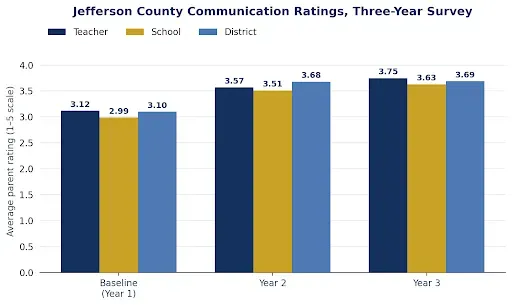
District communication told a different story. It jumped from 3.10 to 3.68 in year two, a 19 percent gain, then held almost exactly there at 3.69 in year three, a movement of roughly a quarter of one percentage point. District trust is the hardest score in any system to move, and the hardest to hold once it moves.
Springer put it plainly. “Year three looked smaller on paper,” she said. “Gains under 4 percent, one score barely moved. That's not stalling. That's what a system looks like once it's no longer new: it holds the gain instead of losing it.” Her read on why that matters more than the bigger year-two jump: “The first jump is such a feel-good win. The second year of movement, the one where the number holds instead of spiking again, is the one that tells you if you built something real or just had a good year.”
Springer pushes that same three-year line down to the building level: every school gets its own one-pager each year, its own data next to its own qualitative feedback, so a principal sees their trend, not a district average.
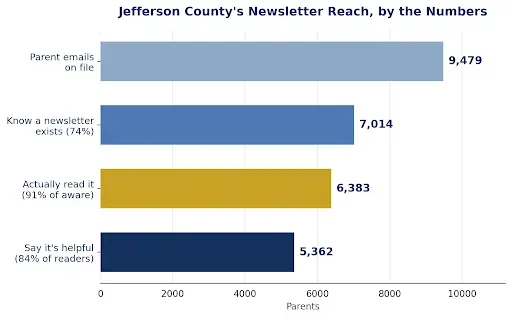
The survey also surfaced a specific, actionable gap: just 74 percent of parents said their school has a newsletter, though all 16 schools publish one. Of the parents who do know it exists, 91 percent actually read it, and 84 percent of those readers say it's helpful. “That was my biggest takeaway,” Springer said. “We're doing all this work that is making dividends, but our survey results said we never actually communicated how we're communicating.” The problem wasn't content. It was awareness.
Springer ran those rates against the district's full contact list: 9,479 parent emails on file for roughly 8,200 students. At 74 percent awareness, that's 7,014 parents who know a newsletter exists. Of those, 91 percent, or 6,383 parents, actually read it. Of that reader base, 84 percent, or 5,362 parents, say it's genuinely helpful. “That's over half of our entire parent list, engaged and getting something useful from a tool that not everyone knows exists,” Springer said. Holding those same read and helpfulness rates steady, closing the awareness gap completely would add roughly 2,243 more readers and about 1,884 more parents who find the newsletter helpful, from awareness alone. “We know what works as communicators,” she said. “Data and surveys are what catch our blind spots. Newsletters aren't dead. We just have to actually tell people they exist.” She posted the same breakdown publicly under the title “Filling the Gap,” walking her own audience through the exact math before the district acted on it.
The same survey told her something she didn't want to hear about her own preferences. Parents ranked text as their top choice for routine, non-emergency contact. “I hate it,” Springer said. “I don't want to be texted, leave me alone. But if that's what they want, they told us that, so then we need to do what they've asked.”
“Tell people they exist” became the actual plan. Rather than treat 74 percent as a ceiling, Springer built closing the remaining 26 points into day-to-day operations: requiring every school to publicize that a newsletter exists rather than assuming families already know, and pushing families back to the district's own channels instead of secondhand social media posts. The district also built a take-home resource for day one of school, ‘How We Communicate,' laying out exactly how it communicates. “It's a lot,” Springer admitted, “but we have a million scenarios to account for, and we still didn't cover them all. It's a starting point, and it creates transparency.” It's the same awareness gap driving the shift off PDF newsletters and onto a web-based tool, where existence and readership can actually be tracked instead of assumed.
Turning a Finding Into a Program
That shift didn't happen all at once. In 2024-25, only 53 percent of parents said their student's school had a newsletter. Among the parents who did know it existed, 87 percent read it, and 77 percent called it helpful. That gap became part of the case for the school communicator program: if every building had someone responsible for publishing and promoting a newsletter, awareness wouldn't be left to chance. By 2025-26, every school had a communicator in place and was expected to publish one — and the district's job shifted from getting newsletters out to making sure families knew they existed. That's what led to the 'How We Communicate' document — the same day-one resource that closed the loop on the district's biggest awareness gap.
The funding came from a question her superintendent asked first. Springer had inherited a department where her only additional staff member split time across technology, HR, and communications. When the superintendent offered to fund a full-time communications position, he asked a more important question before approving anything: “How can you do communications differently than what you're doing?” Springer took the question back to her survey data, looked at what the district needed and what she could see wasn't happening at the school level, and came back asking for a budget for something entirely different: a paid communicator in every building instead of another full-time hire in her own office.
Communicators come from both classes of West Virginia school employee, professional staff like teachers and administrators and service staff like aides and secretaries, whoever in a building wants the role and can commit to it. One condition applies to all of them: a communicator has to work in the school they represent. Since the program launched, the only turnover has come from communicators who left their assigned school entirely. Each one gets clear minimum expectations and full ownership of their own school's information, which lets the district run a distributed communications structure without standing up 16 separate departments.
Compensation is tiered by building level. Elementary communicators receive a $3,000 annual stipend, middle school communicators receive $3,250, and high school communicators receive $3,500, all funded out of the general budget. The full program costs the district roughly $60,000 a year.
The requirements set at launch were kept deliberately minimal: two stories submitted monthly for social media or earned media, one to two newsletters a month, a calendar updated 90 days out, and a current staff directory. The first two weren't arbitrary. “Calendar is one of the number one things parents are using our website for,” Springer said, a finding pulled straight from the survey. The staff directory requirement traces back to the same source of frustration: “I can't hear one more time that they (guardians) don't know how to contact anybody,” she said, tying a routine data-entry task directly to the call volume the program was built to reduce.
The Platform Beneath the Strategy
The survey gave Jefferson County its strategy. Its Apptegy platform gave that strategy somewhere to live. “We consolidated platforms and worked to meet our families where they were,” Springer said of the shift. The district runs its website as the system of record, its district-branded app as a day-to-day access point, Rooms for direct school and classroom communication, and Apptegy's newsletter tool for recurring family updates. School communicators use that same platform to manage the practical information families rely on most, including calendars and staff directories.
That structure matters because the district deliberately does not ask every channel to do the same job. Social media is reserved for positive stories and photos. The website holds official information and durable resources. The app and direct communication tools carry routine updates. Newsletters create a predictable rhythm. The goal isn't publishing everything everywhere. It's making the right information available in the right place, and giving families a consistent sense of where to look for it. Over the same three-year period, families have increasingly named the website and app as their information sources, while reliance on social media has declined.
How the Program Actually Runs
The monthly minimums function as a floor, not a rulebook. Some communicators send a newsletter every Friday; others send exactly one a month and keep it to a handful of resource links. Springer doesn't standardize the format, and she doesn't penalize a building for doing less than another, as long as families at that school are satisfied. “If you didn't send one out a month and your families are happy, we'll measure that,” she said. “If your families come back next year and say they don't feel like they're hearing enough, then I'm going to be on you.” The survey, not Springer's preference, sets the bar.
That same logic extends to voice. Springer writes the superintendent's letter to families herself, and he approves it by awareness rather than by editing it line by line. She tells her communicators to do the same for their principals: write in the principal's voice, not a template's. A newsletter that reads like the person leading the building, she has found, lands better than one that reads like a district form.
The communicators meet as a group periodically, and the most recent session centered on a straightforward mindset correction: a communicator's job is distribution, not content production. If a partner department doesn't supply resources for a newsletter, it isn't the communicator's job to go find them. Part of that same meeting was spent letting communicators see each other's work side by side, which Springer says has done more for quality than any written guideline. “Some of my newsletters, it would take me 45 minutes to read everything in it,” she said. “And then some of them, I pull it up and it's like four resource links.” Comparing notes across that range has helped communicators calibrate what their own families actually want rather than guessing. The next standardization push is structural rather than editorial: getting every school's website organized into the same categories, so a family can find the same type of information in the same place regardless of which of the 16 buildings their child attends.
Principals have raised the program on their own during board presentations, citing reduced phone calls and higher parent satisfaction at the building level. The distinction that a communicator's job is distribution, not content creation, matters most for a role staffed mostly by teachers, a profession not known for delegating. “They're doers,” Springer said. “They don't want to disappoint you either.”
Newsletters as a Contract With Families
Jefferson County's newsletter strategy is built around consistency, not volume. The district sends one monthly family newsletter and a staff newsletter every Friday. Each school sets its own recurring publication date, and once that date is chosen, it becomes a commitment. “If you say you're sending your newsletter out on the third every month, you need to send it on the third every month,” Springer said. “That's a contract between you and your families.” Survey responses also changed what newsletters lead with: upcoming dates and opportunities, not recaps of what already happened. “Tell me when it's happening so I can participate,” is how Springer frames the shift to her communicators.
One more adjustment moved the needle: sending a text with the newsletter link the day after the email went out. Readership jumped. As communicators move off PDF newsletters and onto Apptegy's newsletter tool, ahead of new web accessibility requirements under ADA Title II, the district gains more than a compliance checkbox. It gains real data on open and read rates, tying school-level newsletters back into the same platform Springer uses to measure everything else.
Communication as Customer Service
The survey identified a challenge that content alone couldn't fix. Families generally understood the information the district sent home, but many didn't feel they knew how to help their kids at home with it. Clear communication was working. Clarity by itself wasn't enough.
Families also didn't always feel they got a timely response when they reached out to a school. Springer set a two-business-day standard for parent contact, and treats response time as an enrollment risk rather than a courtesy issue. A parent who can't get a timely answer doesn't just stay frustrated quietly. They show up at the board office, post publicly, or decide the district isn't responsive enough to serve their family. Springer has already named the next layer of work: “Get more proactive: alert people earlier on items instead of reacting after the fact, and keep driving them back to our official sources so read rates climb, and there's one source of truth instead of five secondhand versions.”
Why She Stays With It
Springer's investment in this system isn't only professional. She's a graduate of Jefferson County Schools, her grandparents taught in the district, and her own children are enrolled there now. “I am so deeply proud to work in my community and to do this job that I do,” she said. “I just wanted to support the community that supported me.”
That's the standard she measures the work against, more than any single survey score. “I want people to go out into the world and go, oh, she was educated in Jefferson County, she knows she's good,” Springer said. The three-year survey, the school communicators, the newsletter cadence, and the platform connecting all of it serve the same purpose: helping families see a district worth trusting and a community worth staying connected to.
What Other Districts Can Take From It
Springer's advice to districts considering a similar system is to resist the urge to build something polished before starting. “Just do it,” she said. “Just start. Pick three things you need them to do. I needed calendars updated, I needed a newsletter, I needed staff directories current. And if you don't have time to give feedback every month, that's okay, because they report to the principal too.”
“It's data-driven, gut-led,” is how Springer described the philosophy behind all of it. “Consistency is not glamorous,” she said. “It's just what turns a good year into a pattern people can rely on, and a pattern you can build on.”
Trust like that eventually gets tested with money. Jefferson County's operating levy, in place since 1946 and worth about 20 percent of the district's budget, came up for renewal two years ago. District funds can't be used to campaign for it, so Springer's team ran an information-only push, explaining what the levy funds rather than asking for a yes vote. It passed at 64 percent, the highest general election margin in 18 years.